No doubt freelancing offers flexibility, independence, and freedom, but it also has a flip side. Sometimes freelancers have difficult client experiences, and sometimes clients struggle with freelancers as well. That is why signing a contract matters, as it sets the tone for a professional working relationship. It protects both parties and puts you and the client on the same page about the scope, timeline, and payment plan.
But before you start, it’s worth knowing how these contracts work. It can feel confusing, but don’t worry. We have your back. This blog will help you understand everything from what these contracts are and how they work to what a good template contains. To make this easy, a ready-to-use template is included below so you can draft your own freelance contract. So, let’s jump in!
Did you know? Freelancers Union reported that 71% of freelancers have struggled to collect payment at least once in their careers.
What Is a Freelance Contract?
Just like any other contract, a freelance contract is a legally binding agreement between a freelancer and their client. It lays out why you are being hired, what the project includes, when it is due, and how you will be paid.
It adds clarity, protects both sides, and keeps things professional. Signing it is highly recommended to avoid confusion later.
What Happens If You Don’t Create a Proper Contract?
A contract is meant to protect you legally, and working without one can create avoidable risks. The chances of a dispute go really high, especially when project scope, deadlines, or payment terms are not clearly documented.
Imagine a client calls nonstop, talks rudely, and keeps asking for revisions that were never agreed on. Then they refuse to pay. In a situation like that, a signed contract is your best backup
But keep in mind that not all freelance disputes happen because of bad intentions. A lot of them start because expectations were never written down. That is when problems like these show up.
Scope creep and unpaid extras
This happens when the scope is not clearly defined. The client keeps adding ‘small’ tasks that were not part of the deal. Your contract gives you a clear point to renegotiate scope, timeline, budget, or all three.
Payment delays/financial losses
When payment terms are written down, it is easier to push back on late payments. You can also spell out late fees or pause-of-work rules. It can also spell out what happens if payment is late.
Endless revisions
A contract helps you set a revision limit. Without a limit, the client can drag the project out and keep asking for changes without paying more.
Project duration disputes
Without a proper contract, there can be disputes over the project timeline, which can lead to missed deadlines and delayed approvals.
Sudden cancellation with no fair compensation
Sometimes a project gets canceled halfway through. A contract can spell out what the client still owes for completed work and what happens to the deposit.
Tax filing requirements
Freelancers can be penalized if they don’t have the necessary documents to file their tax return. A contract helps you keep clear proof of what you earned and what work you did. That makes tax time less messy.
Misclassification
Misclassification is another big one. Some clients hire you as a freelancer but then treat you like an employee. They set strict hours. They control how you do the work. They limit your ability to take other clients. It can create tax and legal headaches for both sides. The client may face payroll tax issues, and a freelancer may get stuck in a gray area around pay, benefits, taxes, and control over work. A proper contract clarifies your independent status and protects both sides from unnecessary disputes.
If you run your freelance work as a sole proprietor, you usually report that income on Schedule C with your Form 1040.
Who Freelance Contracts Affect the Most
Freelance contracts are not “one-size-fits-all.” They affect different groups in different ways. It matters most when the project relies on details that are easy to misunderstand and easy to argue about. For instance, things like scope limits, payment timelines, deliverables, revisions, copyright, and other nitty-gritty details. Mainly, it affects new freelancers who are still learning to survive in the industry. Having a contract can stop extra requests from turning into unpaid work.
But keep in mind that it is not limited to beginners only, as experienced freelancers can also face the same consequences if they don’t sign a contract. It protects the work and clarifies what rights a client is buying and the transfer of rights to avoid any confusion about source files, reuse, or ownership. That is why some states, like New York, treat written terms as core protections for freelancers.
A contract can also help with classification, as it acts as proof of your contractor status. It also makes you easier to work with as a clear contract feels like a plan, not just an invoice.
How Do Freelance Contracts Work?
Most freelance agreements follow a simple 6-step process:
- Proposal: The first step in a freelance relationship. It states the terms and conditions, work limits, deadlines, payment, etc., on which both parties decided to work together. Some proposals also include “what’s not agreed on” or “what’s not included” to avoid disputes in the future.
- Contract: In the second step, the proposal is converted into a contract if both the client and the freelancer agree to the terms listed. In this step, you add the legal clarity that proposals don’t have. It includes due dates, late fees, confidentiality, ownership terms, and what happens if the project is cancelled.
- Advance Deposit/Onboarding: This step kicks off the work. Many freelancers take a first deposit or a first milestone payment. In some cases, it only involves getting the client’s data access, logins, brand assets, etc., to move to the next step, which is execution.
- Work Execution: The freelancer starts the work and delivers the agreed milestones. Your contract should explain how change requests work. It should also explain how extra work is priced and how that affects the timeline.
- Review & Acceptance: In this stage, the client reviews the draft and checks whether it meets their demands or not. It works best when there are already set rules for acceptance. Information such as who will approve the work, how feedback will be delivered, and how long the client has to review should be explained beforehand. It should also state what happens if the client goes silent, i.e., automatic acceptance.
- Payment: Lastly, the freelancer delivers the work, and payment is made in accordance with the contract terms.
Types of Freelance Contracts
Based on the payment structure and scope, there are 3 main types of freelance contracts that are widely used in the industry.
1. Project-based / fixed-price contracts
As the name suggests, Fixed-price contracts have a fixed project cost and scope.
The client shares the deliverables up front, and the freelancer quotes a total price. The price will not change once the freelancer commits to it.
These types of contracts are best for projects with clearly defined scopes. For example, Website design, graphic design, etc.
2. Hourly contracts
In hourly contracts, freelancers get paid on an hourly basis. These types of contracts work best when no fixed scope is defined.
These work well for ongoing work where the deliverables shift, or where it is hard to lock scope early. For example, projects regarding consulting, development support, writing, and editing, etc.
3. Retainer / Ongoing Contracts
A retainer/ongoing contract is an agreement in which the client makes a regular payment to a freelancer (typically monthly) to continue receiving services for a specified period.
A retainer contract explains what the monthly fee covers, such as a set number of hours or specific deliverables. It also states what happens to unused time and how either side can end the agreement with notice. For example, social media management, virtual assistance, etc.
Essential Elements of a Freelance Contract
Clauses that can be included in a contract depend on the type of project. However, a strong agreement that protects both the freelancer and the client should consist of a few key elements.
1. Parties and dates
The first and most important thing that a contract should mention is the names and details of both the freelancer and the client. Clearly identifying both parties to the contract and having them agree to it reduces the risk of unwelcome disputes. The contract should also clearly mention the start and end dates of the contract.
2. Scope of work
The scope of work (SOW) provides clear guidelines for the services you, as a freelancer, will deliver to the client. It includes expected deliverables, quality standards, acceptance criteria, the number of revisions, and what work is outside the agreed scope.
Avoid using vague terms that can have multiple nuances. Define exactly which services are included and which are not. This clause saves freelancers from clients’ unreasonable demands.
3. Deliverables and acceptance
This section spells out what you’re delivering and what the process of approval looks like. If you’re working in stages, it also sets milestones so progress and payment stay aligned. Either side can draft this section, but both should agree on the approval process before work starts.
4. Payment terms
A good freelance contract has a clear payment schedule section. It defines how and when you will be paid. Some contractors pay after each milestone, while others make payments at the end of the project. Some freelancers also take advance payments. However, most contracts set a 30-day limit, but it can vary depending on you and your client.
Tip for freelancers: Make sure to include critical terms such as due date, accepted payment methods, late fee/interest rules, and invoice timing.
5. Intellectual property
This section clarifies intellectual property rights and usage licenses of the work. In the U.S, creators own the copyright/IP rights. But they can be transferred if the freelancer signed the written IP assignment or if the work qualifies as “work made for hire”. Freelancers usually sign an IP assignment after full payment. Make sure you are completely paid before signing away full value.
6. Confidentiality
This clause is added so that both client and freelancer can respect each other’s confidentiality even in the case of a dispute. This section helps freelancers understand what information is considered confidential. It also highlights how the information must be stored, for how long, and the consequences of breaching it.
In some sectors, a non-disclosure agreement is also signed in addition to the confidentiality clause. It is a legal document to protect confidential information between two contracting parties. Most clients working on sensitive projects require you to sign it.
It restricts both the service provider and their client from misusing any information provided during the project duration.
7. Termination
A strong termination clause protects both parties from unnoticed terminations and provides a professional exit route. It clearly explains how either party can end the contract, the required notice period, and what happens to unfinished work.
If the project is cancelled due to budget changes or delays, freelancers can include a kill fee. It is a cancellation fee that requires the client to pay you for work already completed. Many freelancers consider the deposit non-refundable and treat it as a kill fee.
8. Signatures
Once both parties are on the same page, they can sign the contract. This confirms that both have read and accepted all the contract terms.
Freelancer contracts aren’t fixed. Depending on the project’s requirements, both the client and the freelancer can incorporate additional clauses, such as governing law, indemnity, insurance, non-compete, non-solicit, mutual representations and warranties, dispute and mediation, etc.
Freelance Contract Template
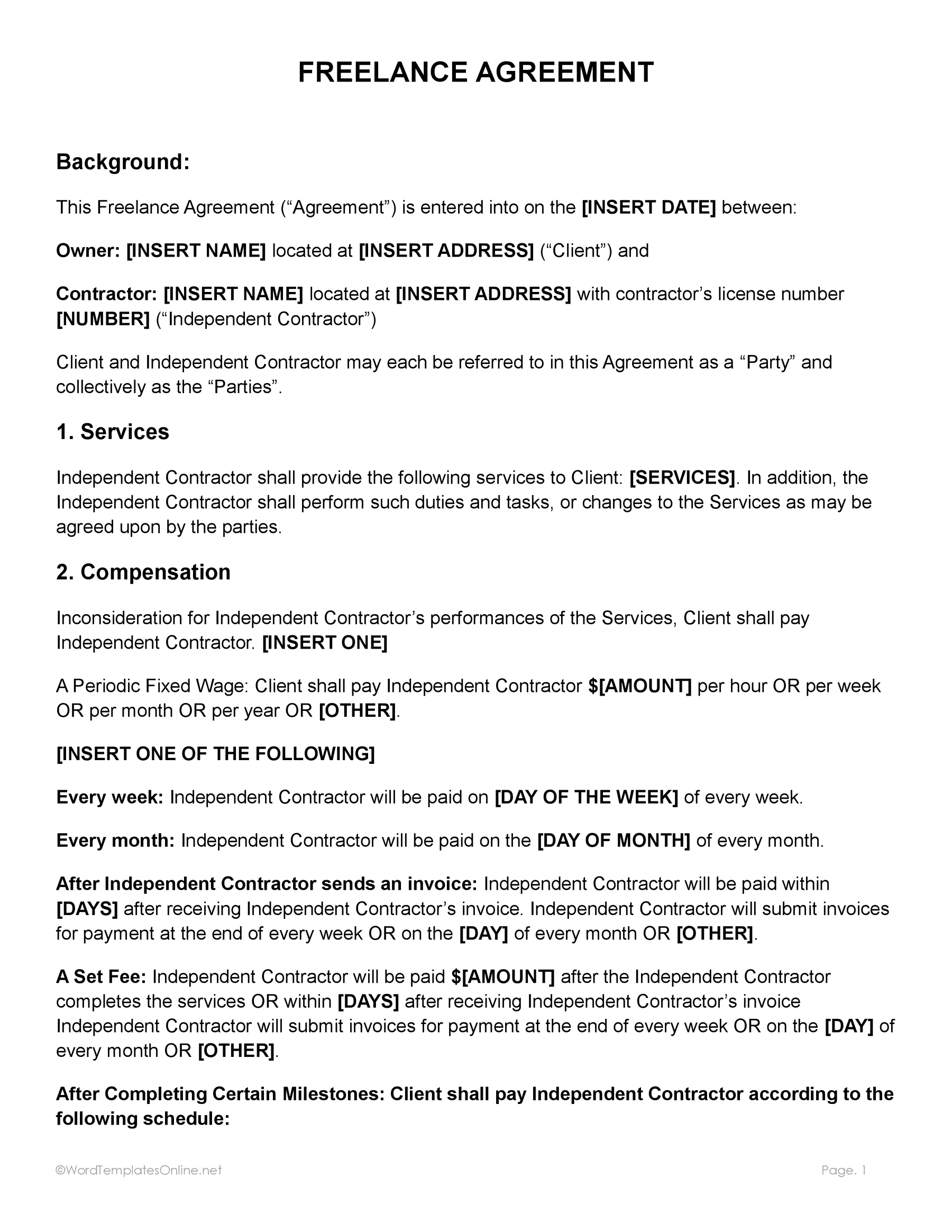
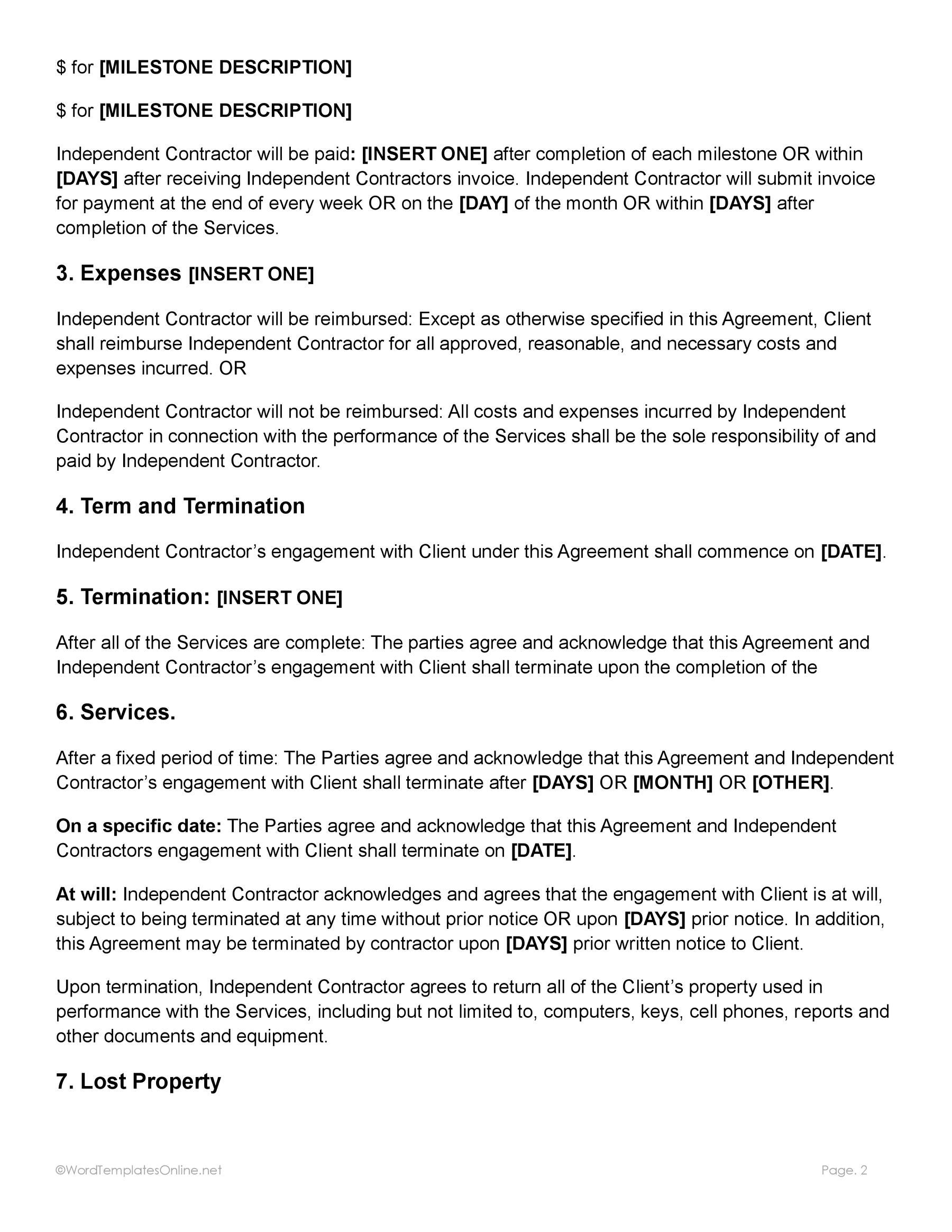
We made a freelance contract template that covers the basics most projects need. It is entirely customizable, editable, and available in Microsoft Word and Google Docs formats. You can easily update text, adjust deadlines, revise fees, or modify clauses to suit their project or agreement.
Our template can be used to clearly describe the services provided and connect the work to defined terms. It also lets you choose a payment plan that matches your project, i.e, hourly, invoicing, fixed fee, or milestones. It further clarifies confusion regarding how you get paid and who covers costs.
It also includes optional clauses like governing law, dispute resolution, and notice rules. Keep what fits your project and delete the rest.
With all legal and professional aspects thoroughly covered, you can confidently use this template for your next assignment without worrying about the right language or essential contract elements.


Who this template is for
This template is multifunctional and can be used by freelancers in creative industries such as designers, developers, writers, marketers, consultants, virtual assistants, editors, and video creators. Marketing specialists, translators, or virtual assistants who provide project-based services can also use this template to create clear contracts and make sure everyone is on the same page.
Other than that, small businesses and startups that want to hire freelancers for one-off projects can also use this ready-made template to draft contracts.
Overall, anyone involved in freelance arrangements can benefit from this contract template and adapt it to their professional requirements easily.
Common Mistakes to Avoid When Writing a Freelance Agreement
People often overlook a few crucial details when agreeing to a freelance arrangement. They may seem minor at the time, but they can quickly turn into bigger issues that affect the entire project.
Let’s have a look at some of the most common ones:
- Unclear scope or deliverables: Accepting projects with a vague scope is one of the biggest mistakes that freelancers make. It can lead to overworking and stress. Use this section effectively and ensure the contract clearly defines deliverables, milestones, and other specifications.
- Vague payment terms: Unclear terms can lead to slower payments, fewer payments, and sometimes no payments at all. Don’t fall for this and be specific about your fee.
- Ignoring IP rights: Not clarifying who owns the work (and when ownership transfers) can lead to disputes over reuse and edits. Make sure to settle this with your client to avoid any inconvenience.
- Skipping termination or revision clauses: Without clearly defined termination and revision clauses, freelancers risk sudden cancellations and overwork. Always specify a notice period, kill fee, and termination for cause to avoid these circumstances.
Frequently Asked Questions
What does “work made for hire” mean?
‘Work made for hire” basically means that the client will be the legal author and owns all the copyrights. It is usually signed when the client wants ownership of the project from the start. It works when there is a written agreement saying it’s “work made for hire.”
Can I show the work in my portfolio if the client owns the rights?
It actually depends on the contract, but in most cases, you can. Just make sure to include a portfolio clause in your contract that allows you to display your work as self-promotion. If the project is confidential, you should get the client’s written permission before using it.
About This Article