
You’ve read a mountain of articles, scribbled a million notes, and now…. the blank page is intimidating you, and one thought is rushing in your mind: How do I write a comprehensive literature review without making it messy?.
Let’s clear one myth: a literature review is not just a long summary of other people’s work. It is actually one of the strategic parts of your research that shows your real understanding of the theories, the debates, the evidence, and the gaps in your field. Done right, it authenticates research. Done poorly, it weakens your entire paper.
That’s why you need a structured literature review template that helps you organize theories, validate empirical research, and clearly highlight the research gap, without sounding repetitive or scattered.
In this article, we’ll break down the structure step by step and introduce you to six practical templates so that your literature review section will not just be an ordinary one.
Literature Review: What You Need to Know
As the name suggests, it is basically a well-defined overview of what researchers have already said about your topic. Many students generally underestimate this section; however, it is one of the most significant sections for making research credible. In this section, you write a summary of the relevant studies and analyze, compare, and connect them to your topic so you can show where your work fits. In simple words, it tells what is known already and what you are bringing to the table.
If you have ever written a thesis or dissertation, you might be aware that the literature review usually comes as a full chapter and makes a strong foundation for your research. Additionally, it tells examiners and supervisors that some work has been done in this field and that you understand it deeply. On the other hand, in research papers, it may be shorter, but it still has a leading role as it justifies your research question and proves that your study adds something new to the conversation.
Why you need a literature review template
The world is adapting fast, research is evolving, and academic writing is becoming more structured, so why rely on orthodox and trial-and-error methods when writing your literature review? Instead of spending hours thinking about what should come first or worrying about if you’ve missed something important, a template gives you a clear and modern roadmap.
One of the other important thoughts that surfaces when writing a review is, “Am I going off track? “ Well, a template prevents you from back-and-forth editing and helps you stay organized throughout from opening to conclusion, and honestly, this is the whole point of a good literature review. In short, whether you’re managing a small undergrad paper or drafting a full PhD dissertation, using the template just makes the whole process simpler, smoother, and less overwhelming.
What Goes Inside a Standard Literature Review Format
Stop staring at your screen, wondering how to put the literature review section into writing. BECAUSE there’s a clear flow to follow and we know it.
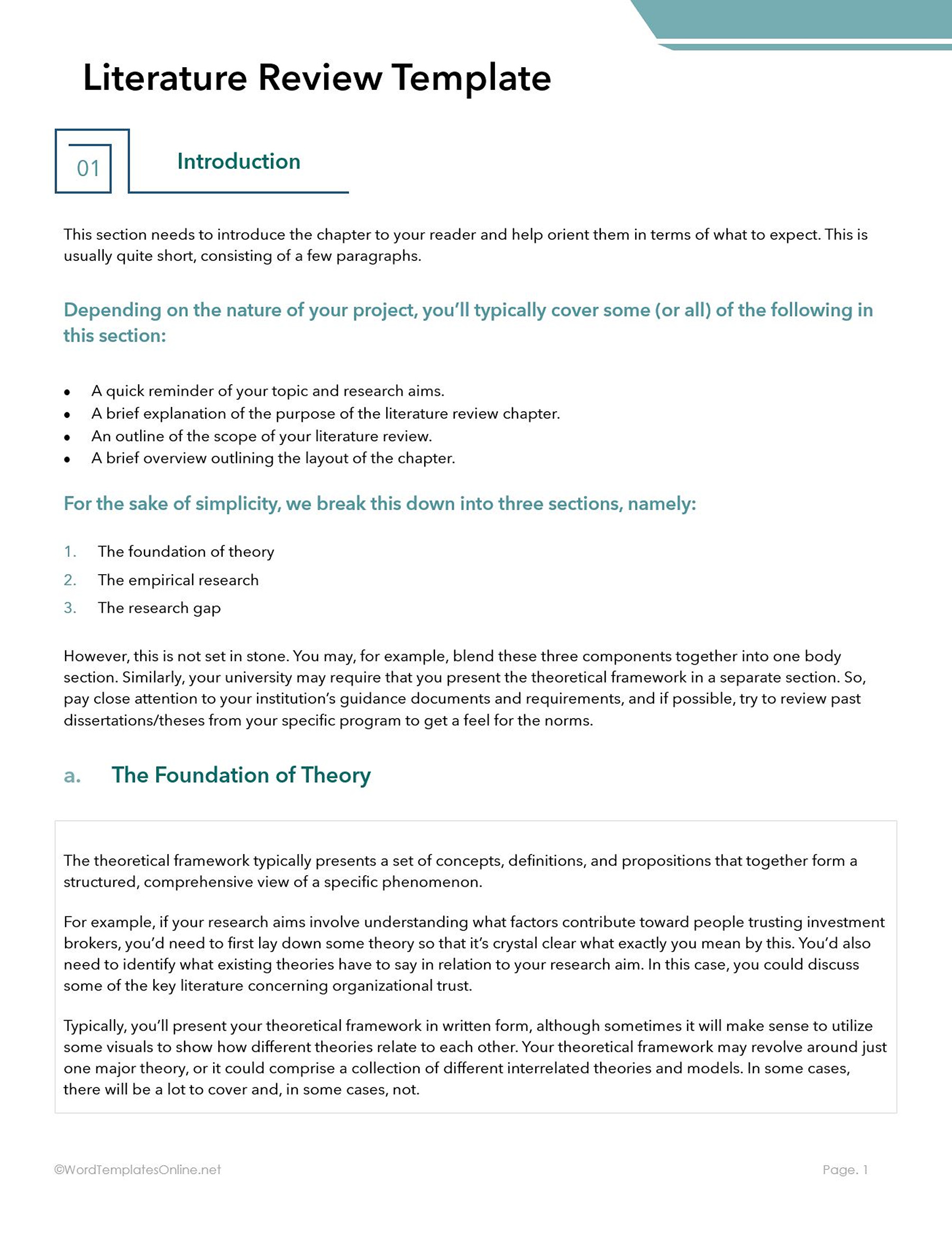
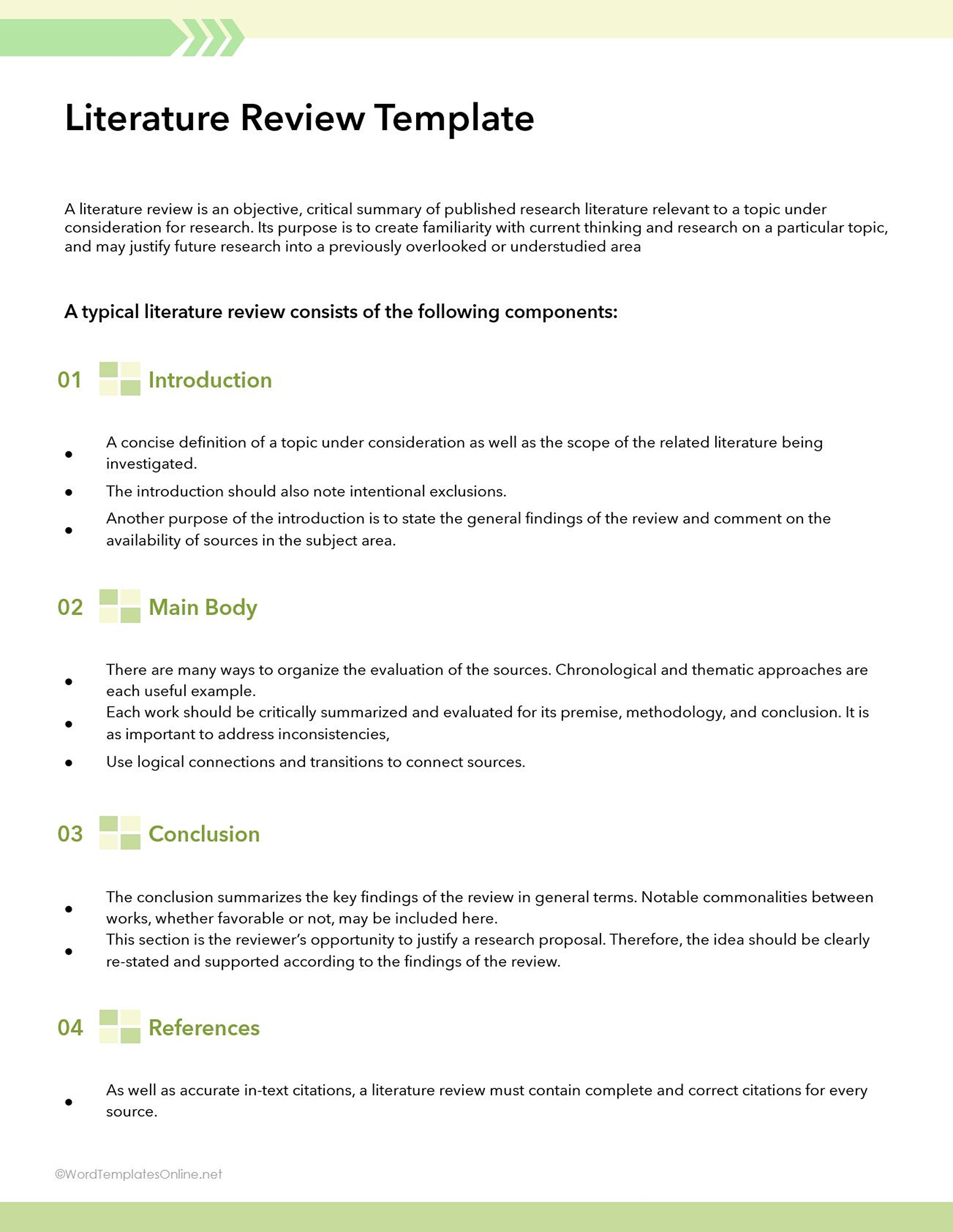
1. Introduction section (background, objectives, research problem)
Without a second thought, the first part is the section. Here you briefly explain your topic, tell readers why it matters, and emphasize your research question. This is actually a place where you set the scene. Think of it as warming up your reader. Moreover, in this part, you also introduce your key objectives so that the audience knows what direction you are heading in. Keep it clear, documented, and purposeful, no rambling.
2. Theoretical framework (foundation of theory)
Here’s where you will introduce your big ideas. What theories explain your topic? Which models are being researched? This section indicates that you are aware of the intellectual foundation of your field. One of the common myths about this part is “it is just about copying and pasting definitions.” Well, it is not, in fact, you thoroughly and diagrammatically explain how these theories connect to your research.
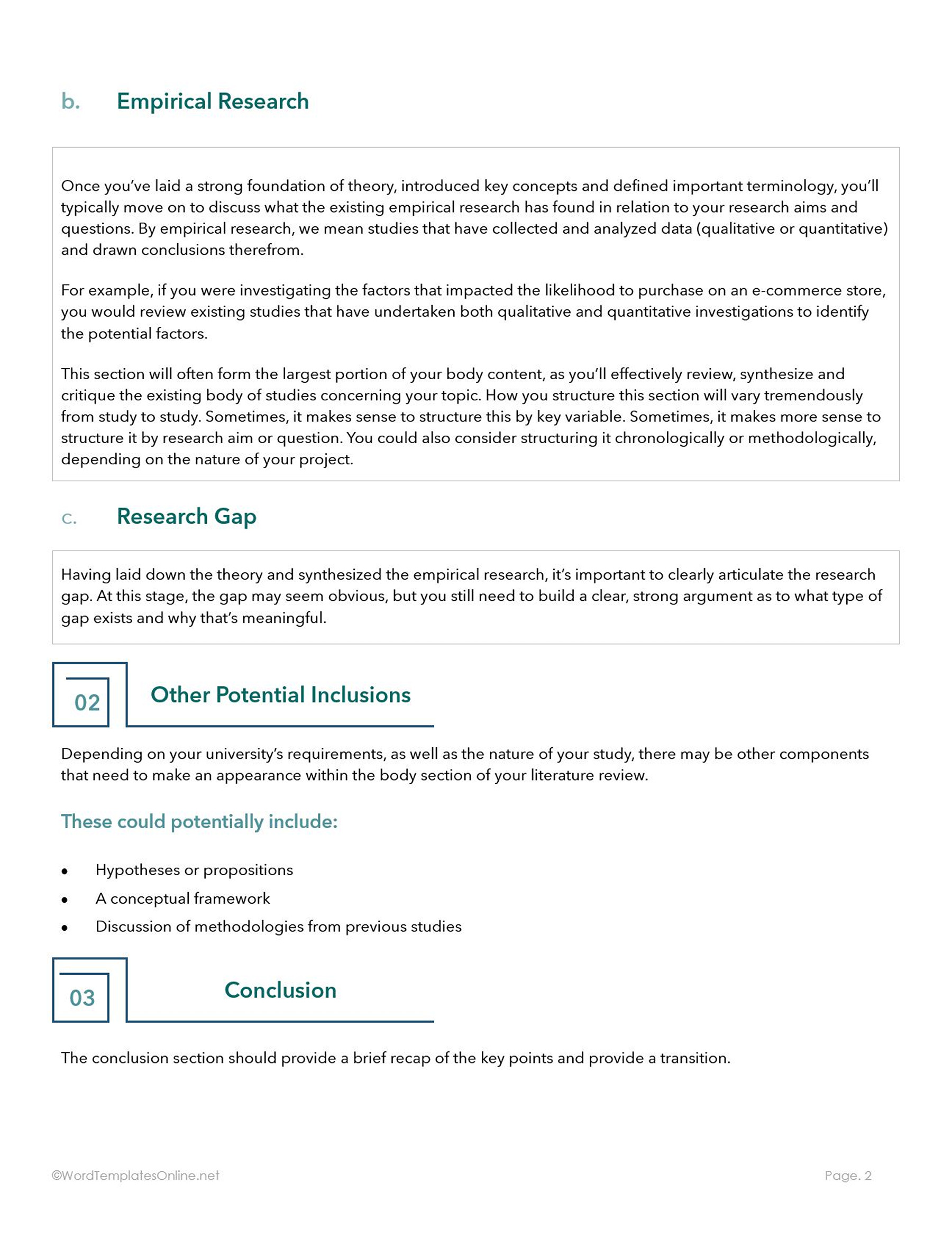
3. Empirical research review (previous studies and findings)
This is the heart of your research. Now you will plunge your head into previous studies, what researchers found, how they conducted their studies, and what the results are. Instead of filling this part with one study after another, try to compare them. Group them by themes or subthemes so your review feels connected, not scattered.
4. Research gap identification
This is the “aha” moment. After reviewing all those studies, you will find the exact gap. There might be conflicting results, maybe a certain demographic has been missed, or maybe methods are limited. This section is important because it naturally leads to your research.
5. Hypotheses of research questions (if required)
If your research includes hypotheses or research questions, this is where you will list them. You show how the literature supports them. It’s like saying, based on everything I found, here’s what I’m going to test or explore.”
6. Conceptual framework (optional section)
In extensive research or dissertations, you will need to include a conceptual framework. Here, you will visually explain how your variables connect. Think of it as mapping your study into a clear, logical way so readers can easily see the correlation between your variables.
7. Literature review conclusion and chapter summary
Finally, it’s time to hit the main points. Wrap your review by highlighting but ideas, hint at what’s coming, and flow into the next chapter without a hitch.
How to Organize the Literature Review Section
This is the most important step, as once you start gathering research papers, things quickly get chaotic. Here are the following ways through which you can easily organize your literature review in a clear way, instead of jumping from one study to another.
Organizing by themes
In qualitative research, this is the most common approach. Here, you will investigate studies and take out key themes and subthemes. Once you list all the related subthemes, group them under a major concept. For example, if your topic is how remote work impacts productivity, the emerging themes would be employee motivation, work-life balance, and virtual collaboration.
Organizing chronologically
The other way is to arrange the studies based on time. Such as, kick things off with older students and move to the latest one. Through this way, readers get to see how ideas and findings have changed over time.
Organizing by research methodology
Researchers also organize studies by how they were done (research method). For instance, they start with listing qualitative first, then move to quantitative, and in the last add mixed-methods to highlight the key difference.
Organizing by variables or concepts
If your research revolves around specific factors, this method works great. You arrange your studies around key variables and concepts, such as salary, workplace culture, and leadership style, for a job satisfaction study. Through this, you can easily connect the literature to your topic.
5 Free Literature Review Templates: Pick Yours!
Time for the truth: we know structuring all of this feels a bit overwhelming. Don’t worry, that’s why templates exist. Below are the 5 most practical ones that you can use in your coming research:
General academic literature review template
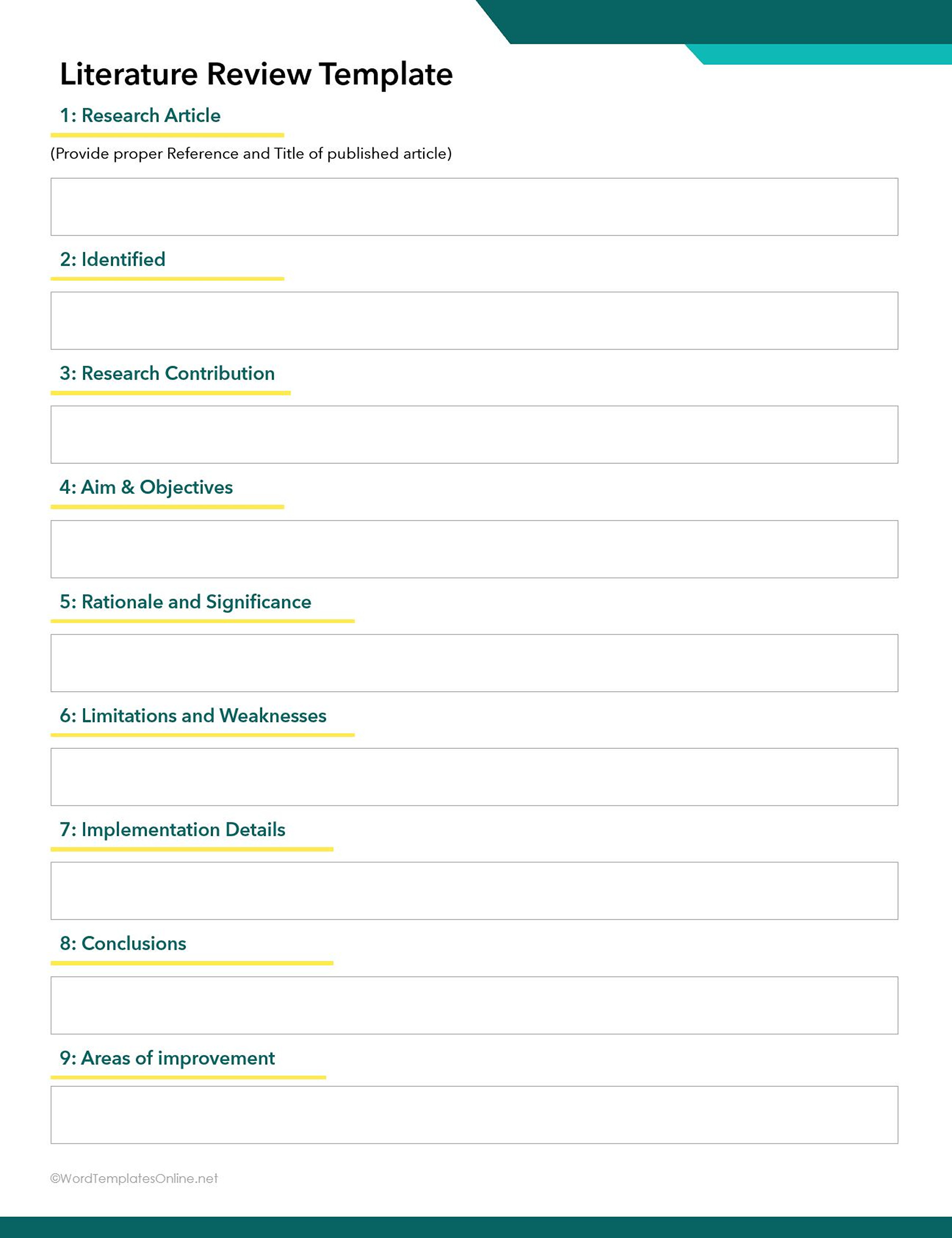
This is a go-to template for most students and researchers. It follows a simple and flexible structure and covers important points such as research contribution, objectives, limitations, and conclusions.
Systematic literature review template
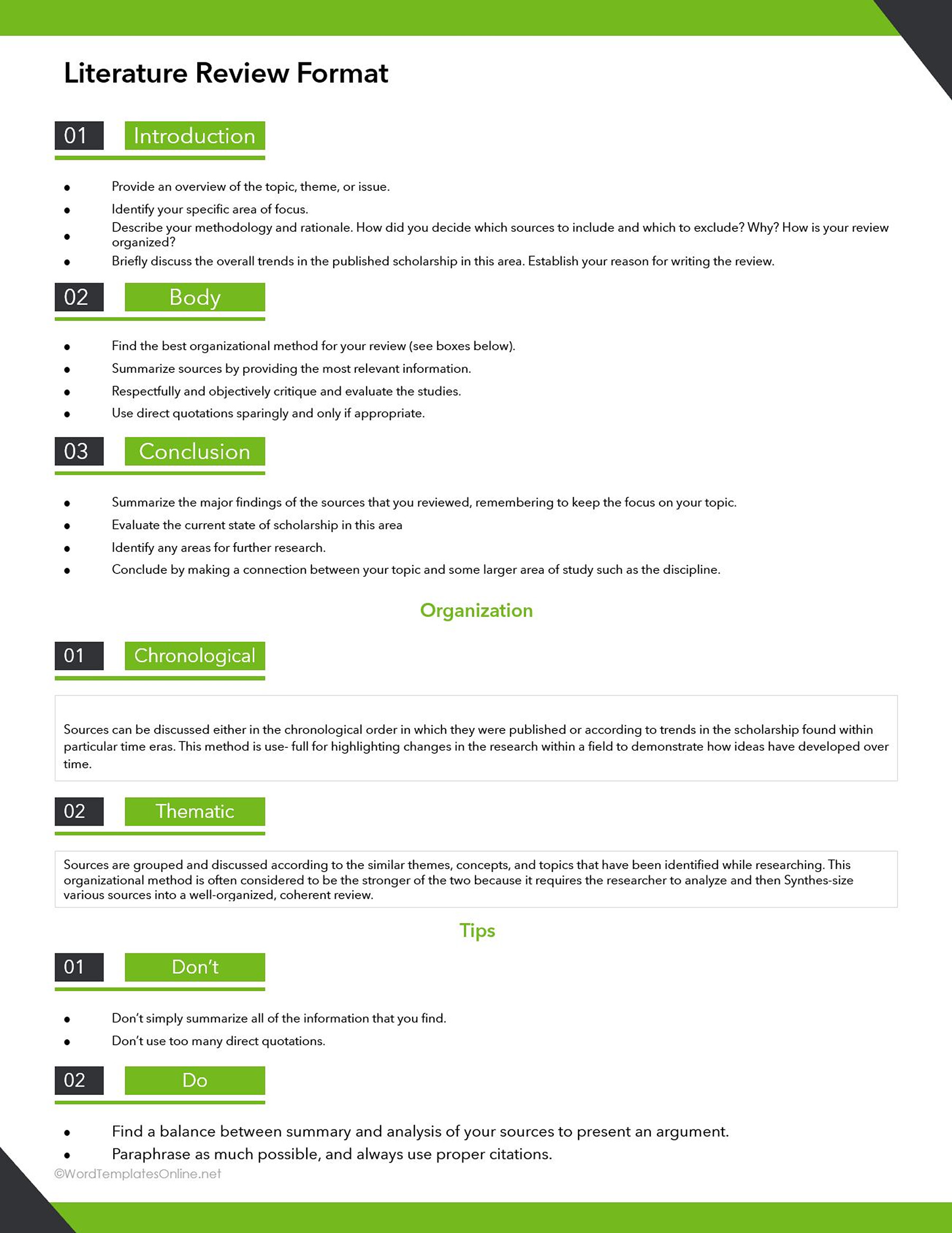
You can use this template if your research is more rigorous and systemic. With clearly defined sections, the template makes it easy for you to review literature first and then organize it by themes or in a chronological way (your call). On top of that, it even throws practical tips about the right way to handle academic records and common mistakes to avoid.
Empirical research literature review template
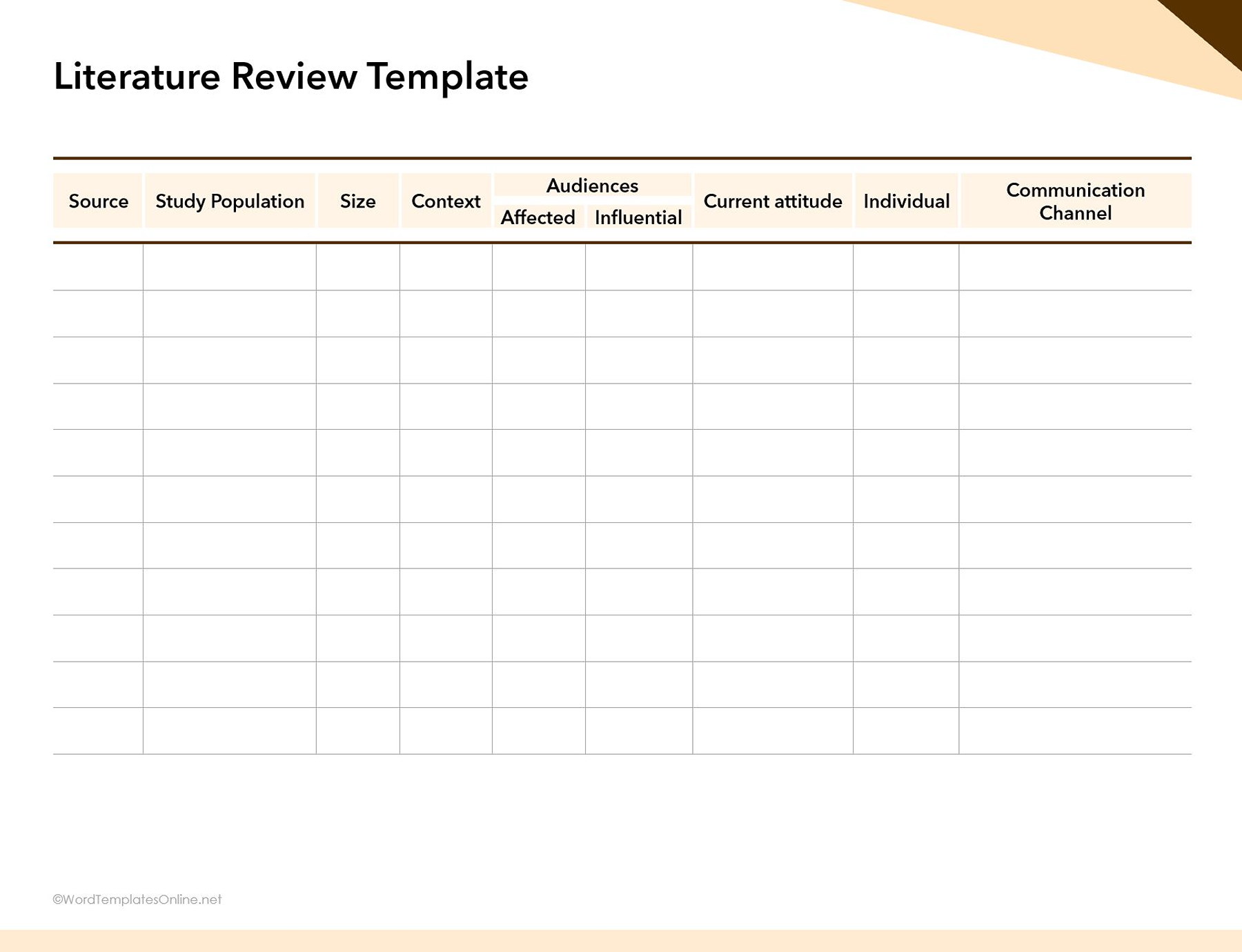
If you are analyzing empirical studies by comparing different research papers, then this template helps you do that in a structured table. As shown, each row represents a different study, while the columns cater to important details like demographics, source, sample size, audience affected, research context, and communication. By filling out this table, you can instantly record key details and see patterns across studies.
Process-based literature review template
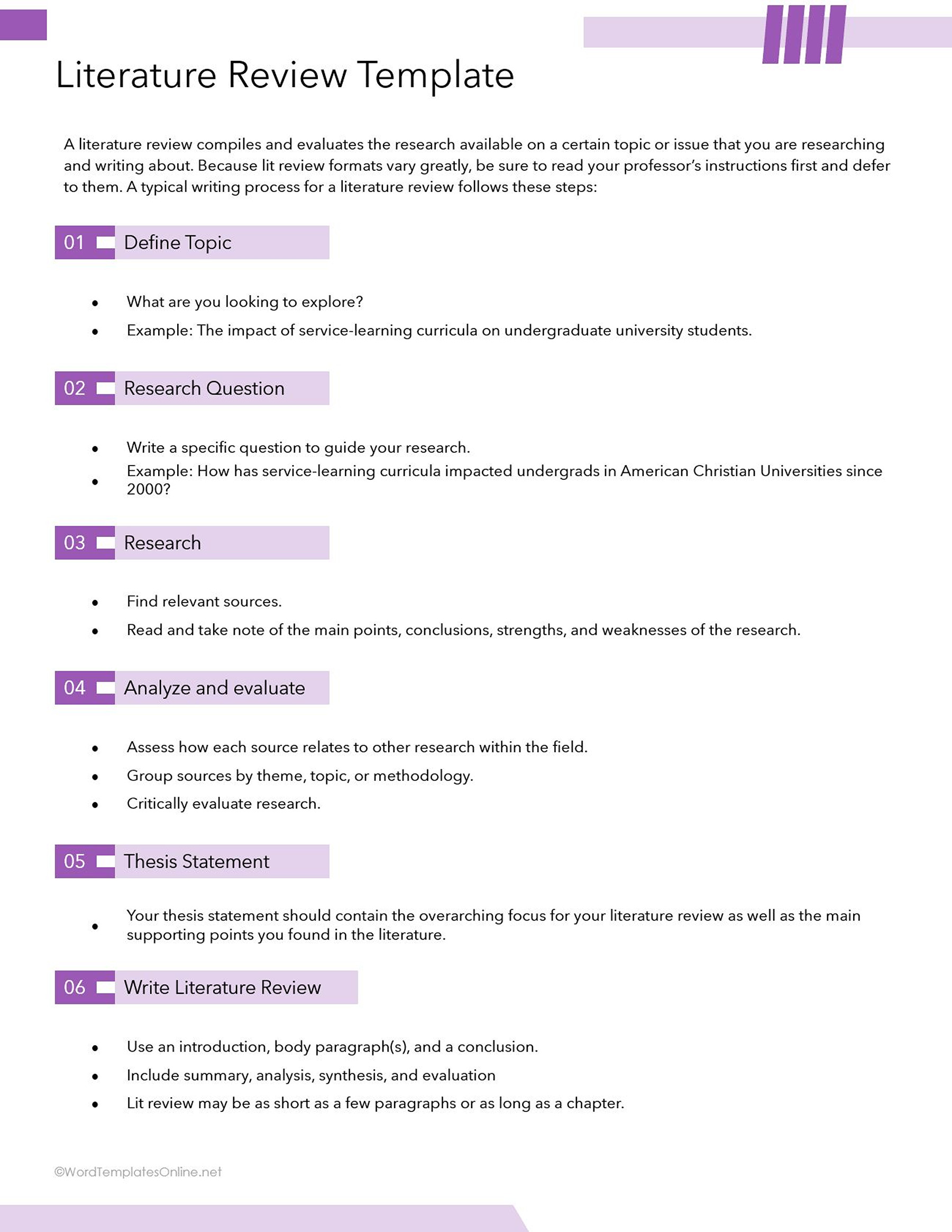
This template acts as your complete roadmap for research. Rather than pushing you directly into writing, it first helps you sort your ideas, develop a strong understanding, come up with research questions, collect sources, and then shape everything into a clear perspective.
Thematic literature review template
Instead of following a strike timeline or just listing sources, this template compiles the literature into conceptual sections. For example, it groups studies into themes like theoretical foundation, empirical research, and research, making it easier for the reader to quickly grasp how different studies connect and where new research opportunities exist.
How to Rock Your Literature Review: Some Amazing Tips
A literature review can make or break your research. That’s why we have come up with the powerful tips that can prove to be your savior:
Tip 1: Start with a clear research question
There’s a saying, “a calm mind is a clear mind”. So, before diving into piles of articles, carefully and logically think about what you actually want to explore. Without definite objectives, it is really easy to get off track.
Tip 2: Forge yourself in reliable academic sources
Skip the random clickbait. Always look for the academic journals and articles that really dig into your topic and are worth adding to your review.
Tip 3: Filter out the most relevant studies
Listing every study you find around your topic only dilutes your literature review. Choose useful sources only! For this, quickly review abstracts and introductions to decide which studies are worth including.
Tip 4: Note it, save it
Write down every key point you find relevant in every study. This will make it easy for you to structure everything seamlessly without missing any important details.
Tip 5: Grouped studies into themes or categories
Instead of overflowing your review with information randomly, group them by common ideas, themes, or approaches. This makes your chapter look good, presentable, and comprehensible.
Tip 6: Analyze, compare, and synthesize findings
Connecting your research with other studies is what hooked your readers. Make sure to show how studies relate to each other. Do they agree? Do they contradict each other? Additionally, this is where your analysis really starts to shine.
Common Mistakes to Avoid in Literature Review
Not all, but the majority of the literature review lost its impact because of a few common mistakes. Let’s find out:
- Summarizing instead of critically analyzing: If you directly list study one after one, it loses its actual essence and does not add much value. Rather than summarizing the studies, focus on connecting the dots and compare it with your actual topic.
- Missing or weak research gap: Most importantly, your literature review should naturally lead to the question: “What’s still missing? If the research gap isn’t, what is the point of your study then?
- Lack of structure and flow: A disoriented review that jumps from one study to another randomly will quickly lose the interest of readers. That’s why it is necessary to follow the clear structure, whether by themes, timeline, or concepts (your choice), to keep everything organized.
- Using outdated or non-scholarly sources: Most researchers add old studies and unreliable sources, which negatively impact their argument. Whenever possible, stick to reliable and most recent academic research.
- Quoting too much: Well, don’t go quote-crazy. Using too many quotes clogs up your review. Always try to explain ideas in your own words while crediting the source.
Literature Review Template Formatting Guidelines
Formatting might seem like a little detail, but it’s completely changed the look of your literature review. Just a few amendments and see how it elevates the entire section:
- Recommended Word Count by Academic Level: Not all literature reviews require the same word length. It usually depends on the level of research, such as undergraduate papers are often shorter, while master’s and PhD theses require a more extensive review.
- Citation Styles (APA, MLA, Chicago, Harvard): Every institution and university have their favourite citation style. Just pick the one you’re supposed to use and be consistent. Don’t match and mix!
- Proper Use of Headings and Subheadings: Headings aren’t just fancy; they guide the readers and make your discussion easy to follow.
- Paragraph Structure and Academic Tone: Do not exceed the paragraph by more than 150 words. Keep them focused on one idea and write in a clear, academic tone.
- Using Tables to Summarize Studies: When you have to analyze multiple studies, tables are the best way to showcase complex information in a simpler and comprehensible format. For this, you can use our empirical research template mentioned above.
Conclusion
Basically, a literature review isn’t just a long list of studies; it’s your chance to show how they all fit together with your topic.
We know writing might seem intimidating at first, but once you get the right idea and template, the process becomes really easy. Instead of feeling lost in dozens of research papers, you’ll have a clear path to ideate, compare studies, and find out what’s actually missing. Additionally, the templates we discussed are there to guide you so you’re not starting at a blank page, wondering where to begin.
Frequently Asked Questions
What is the difference between a literature review and an annotated bibliography?
Well, we might confuse them as the same thing, but they aren’t. A literature review evaluates and connects multiple studies to discover patterns and research gaps. Whereas an annotated bibliography simply gives short summaries of different individual research.
Can I edit the templates?
Of course. The templates come in an editable format so that you can easily customize them according to your needs.
About This Article