Monday is all about handing students a new spelling list, and by Friday, it’s time for the big test. The words are ready, the students have practiced, but then comes the annoying part: making a spelling test sheet.
You already have a lot on your plate, such as lesson planning, grading, emails, and designing the sheet, which makes your schedule even tighter. Because apparently, even a ten-word quiz needs its own design.
That’s where a spelling test template comes in handy. Instead of putting a black sheet into numbering, spacing, and arranging lines, it gives you a ready-made format to give to students and TADA!. This way, you spend more time teaching, not on formatting and boxes.
So, Why a Spelling Test Template Is a Must-Have
Well, consider a template a ready-to-use worksheet that takes the effort of putting together a spelling test. With this, you need to figure out where everything should go, as you have a clean layout for the word list, student details, answers, and score.
Remember, a spelling list is what students study, and a test is where they show that they actually learned.
The best thing about these templates is that they can fit into all sorts of learning routines, and that’s what makes them a must-have. Let’s say, if you’re a teacher, you can use it for weekly spelling tests, while parents can use it for quick homeschool or at-home practice checks.
Apart from this, it’s also handy for tutoring sessions, small group activities, or an end-of-chapter assessment where you want to see which students have nailed it and which need more attention.
In addition to the reinforcement, a worksheet saves you time and keeps your test looking consistent and familiar, making grading a little less of a chore. Students get a clear place to write each answer, while you can reuse the same format for a new word list.
What Should Be Included in a Spelling Test Template
A good spelling test doesn’t mean it should look aesthetic or be a paperwork monster. It just needs the right elements in the right place; Let’s have a look:
1. Student name and date
Every template starts with a top section where you need to put the student name, grade, class, and test date. It’s quite basic, but this thing will save you from guessing, “Whose paper is this?’ later.
2. Spelling word section
Next is the spelling section, which is followed by a numbered spot for each word. This makes sure that students don’t get lost and write each word after one number to keep things nice and tidy.
3. Answer spaces
Well, those spelling words need somewhere to land! These answer spaces are those boxes and clear lines that give enough room for students to write letters neatly without squeezing them.
4. Score or points section
A template must have a little space to score the test and add a percentage or grade. Once you are done with the checking, write the score in this particular box.
5. Teacher notes (optional)
Some templates have a small note section, which comes in handy for quick feedback, corrections, or reminders. Nothing fancy, just enough space to leave a helpful note when needed.
Spelling Test Template Types and Formats
Not every spelling test has to follow the same old “I say it, you spell it” routine. Based on your students and what you’re trying to check, you can switch things up with different template formats.
Traditional dictation test
The classic template never goes out of style. Here, a teacher reads each word aloud, and students have to write what they hear and then move on to the next one. A simple layout with numbered words and answer lines keeps the whole process nice and simple.
Spelling Test Template 01

Spelling Test Template 01
Weekly spelling test template
This bright template is what you need to make dull, high-pressure spelling test day into a classroom favorite that actually keeps students engaged. By fitting two tests onto a single vibrant sheet, you save paper while cutting prep time in half.
The clean, friendly layout features 25 spacious, numbered lines, giving students enough space to write words without feeling cramped. Additionally, it’s perfect for classroom assessment, weekly tests, or spelling activities that won’t feel dreaded.
Spelling Test Template 02
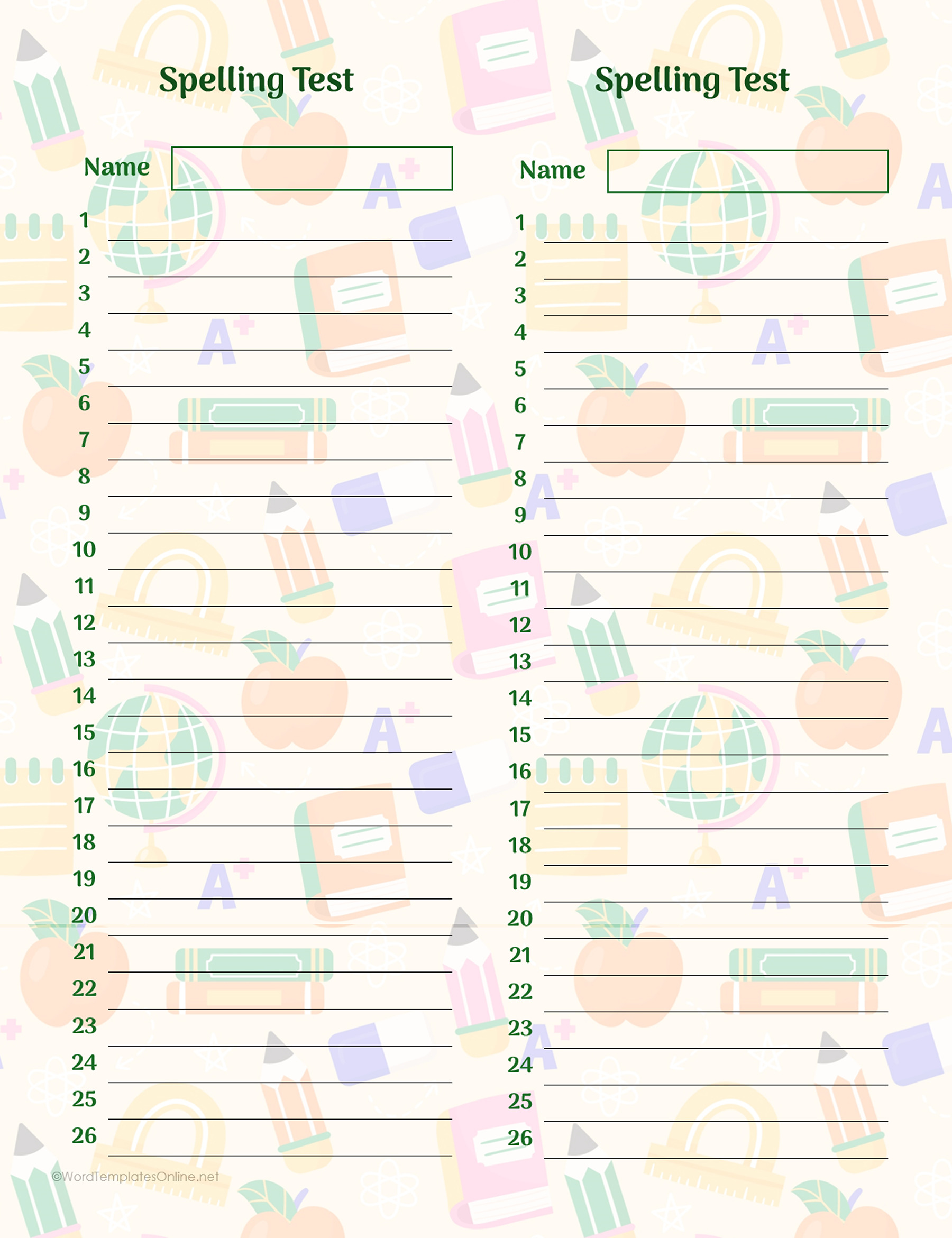
Spelling Test Template 02
Diagnostic spelling test template
It serves the same purpose as any spelling test, but it takes an assessment a step further by giving you more than just spaces for words. Apart from including the name, age, grade, and date section, it also adds fields for total, right, grade equivalent, first missed, tension of learning level, and section placement.
Below the basics, it gives 25 numbered lines in two side-by-side sections, giving plenty of room for a longer spelling assessment. It is useful when you want to record how students perform, as well as a few key assessment results alongside their test.
Spelling Test Template 03

Spelling Test Template 03
Development spelling test template
Not all tests are designed to just count right and wrong answers; some also go into a more structured approach and look at a student’s spelling development. This template does exactly that. It has rows for individual words and columns for different spelling stages, such as Precommunication, Semiphonetic, Phonetic, Transitional, and Conventional stages.
Moreover, the grid structure is made for teachers so that they can easily find out the spelling stage after students spell each word. This is really helpful when you’re assessing spelling patterns, tracking progress, and spotting areas where students need more attention.
Spelling Test Template 04

Spelling Test Template 04
Spelling practice & test template
This one turns a basic spelling test into a mini spelling challenge with four easy-to-follow steps. First of all, students kick things off by writing their base words. After that, they sort them into alphabetical order and break them down into syllables using dots for a hands-on learning experience.
Finally, the journey comes to an end with a simulated practice test that locks in their confidence before the official test day. With 20 spaces per section and crystal-clear instructions, this template is best for testing and practicing.
Spelling Test Template 05

Spelling Test Template 05
Spelling test record sheet
If you want to keep spelling progress neat and easy without any organizing clutter, this template helps you do so. This grid-style layout features dedicated name and class fields alongside a spacious word list section built for recording longer vocabulary sets or tracking scores over time.
Moreover, it offers a clean, simple way to check student growth week after week without getting bogged down by complicated formatting.
Spelling Test Template 06

Spelling Test Template 07

Spelling Test Template 08

Spelling Test Template 09

Spelling Test Template 10

Spelling Test Template 11

Spelling Test Template 12

How to Make Spelling Tests More Effective
Getting a good template is one thing, but making the most of a spelling test is another. It should be like a Friday ritual where students write words and wait for the red marks. A few smart tweaks can make the testing more useful.
- Mix Familiar and New Words: The best way is to start with words that students have practiced a lot. The comfortable starting point sets the tone and boosts their confidence. After this, go for a little harder words.
- Test Words in Context: Don’t just randomly throw words at students one by one. If a word is difficult, pop some short, simple sentences so they hear the word in context and connect spelling with meaning.
- Keep the Word Count Manageable: More words don’t necessarily mean more learning. Keep the list right for the student’s age, grade, and caliber so that tests don’t feel like a running marathon.
- Review Misspelled Words: A wrong answer doesn’t mean a red cross; it’s a clue. Go back over those tricky words and give students another chance to practice and correct them.
- Use Regular Practice Between Tests: A little practice throughout the week can make a big difference before the actual test. You can use our practice templates to make this thing a really fun activity rather than a hassle.
Common Spelling Test Mistakes to Avoid
The thing is, even a simple spelling test can go a little sideways if the setup isn’t right. So, make sure you look for these slip-ups and avoid them.
- Testing Words Students Haven’t Practiced: Surprise quizzes are one thing; surprise vocabulary is another! So, make sure you test the words that the student actually learned and practiced in order to measure accurate progress.
- Forgetting to Check the Answer Key: Before you hand over the test, give your answers a quick check. Even a small typo in the key can turn grading into a whole new spelling mystery.
- Skipping the Review After the Test: Well, don’t let missed words simply get the red marks and move on. Use them to find out which words need another round of practice.
- Giving Everyone the Same Difficulty: The fact is, not all students learn at the same pace. So, when right, adjust word difficulty or expectations so the assessment matches the learner.
Final Thoughts
Spelling practice doesn’t need to be a weekly battle of word lists, test anxiety, and “Wait, how do I format this?” A good spelling test template gives you a pre-built format so you don’t need to waste time fussing with the page and more time helping students master those tricky words. So, whether you’re checking weekly spelling, reviewing difficult words, or tracking progress, the right template can keep things simple and student-friendly.
Frequently Asked Questions
How many words should be on a spelling test?
There’s absolutely no magic number! Just keep in mind to make the list age-appropriate and manageable, based on the student grade and learning level.
Can I customize a spelling test template?
Absolutely! That’s what makes our template top-notch. You can edit or swap new words, adjust the formatting, or add sections to fit your needs.
About This Article