You fix the problem for the third time, only to see it pop up again next week. Sound familiar? No matter what the problem is, whether your project keeps missing deadlines, code might break in testing once again, or your team keeps making the same mistakes, this quickly becomes dreadful.
Although you can patch the issue, remind everyone to be more careful, and move on. But if you never figure out what the real problem is, you’re basically putting a bandage on a leak.
That’s why we recommend using the 5 Whys method; it helps you find the “Why” of an issue rather than answers or solutions. Plus, using a template makes your job easier, as it gives you a clear space to write the problem, identify the root cause, and decide what to do next.
Is the 5 Whys Method Still Trendy?
Why not? In fact, it is one of the simplest root cause analysis techniques that lets you figure out what’s really behind an issue. Moreover, this literally wants you to explore more, as it doesn’t stop you at the most obvious answers. You will keep asking “Why did this happen?” until you reach the closest cause.
One thing: the five is not a hard rule; you can even reach the answer after three whys or need seven. The goal here is simply to move past the symptoms and find a cause you can actually fix.
When Should You Use a 5 Whys Analysis?
One question that keeps lingering in your mind is: when do I actually use it? Well, there are many possible ways, such as when problems keep coming back, a quick fix isn’t really working, or you want to know what went wrong in the first place.
Other than that, it can also be used for everything from missed deadlines and workflow
failures to quality issues, machine hiccups, and recurring workplace mistakes.
You now know everything is manageable if you have the right template. Yes, it makes the process a lot easier by giving you a ready-made format. You can clearly write the problem statement, identify the “whys “, connect the answers, and reach a decision.
Let’s explore more.
What’s Inside a 5 Why Template?
Let me clear one thing: a 5-Why template doesn’t mean that it has only a WHYS section. A perfect layout has different sections that help you find the causes as well as reach a conclusion. Here’s what a “reliable one” looks like:
5 Whys Template 09
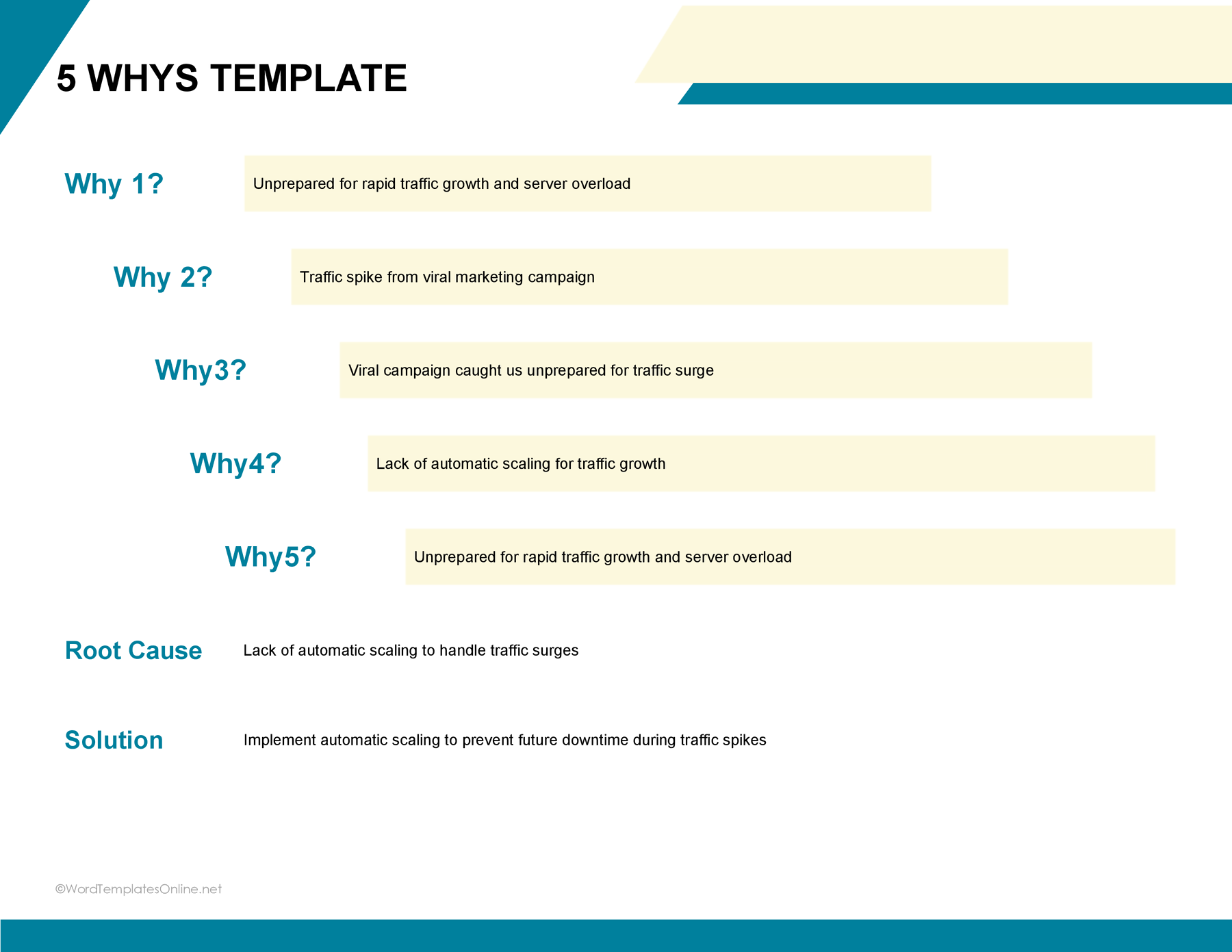
5 Whys Template 09
1. Problem Statement
If not a detailed section, every template must have this primary section. Here, you will write down what actually went wrong. A clear problem statement gives you a starting point so that your focus is on that specific issue.
2. Why #1 to Why #5
Here’s where the real detective work happens. At every “Why” section, you need to think and record the answer. Through this, you can dig into the past and look at the most obvious cause.
3. Root Cause
Once you’ve worked with the above section, it is easy for you to pin down the exact underlying cause. Basically, it’s where you answer, “Okay, so what’s actually causing all this?”
4. Corrective Action
These templates are not only for finding the main problem. Getting to the exact problem is only half the job. This section lets you note what needs to change so you can address the root cause rather than continuously putting out the same fire.
5. Notes, Evidence, or Additional Details (Optional)
Sometimes, to support the findings, you need facts and observations. This space keeps those details together, making it easy to see how you reached the root cause.
6. Action Owner and Follow-Up
If your template has these fields, they help turn analysis into action. You can write who’s responsible for the fix and when to check back, so the solution doesn’t get stuck on paper.
5 Why Templates for Different Problem-Solving Needs
Well, not all problems are the same, and you can’t use one template for all the cases. That’s the reason we’ve come up with different templates. Let’s have a look:
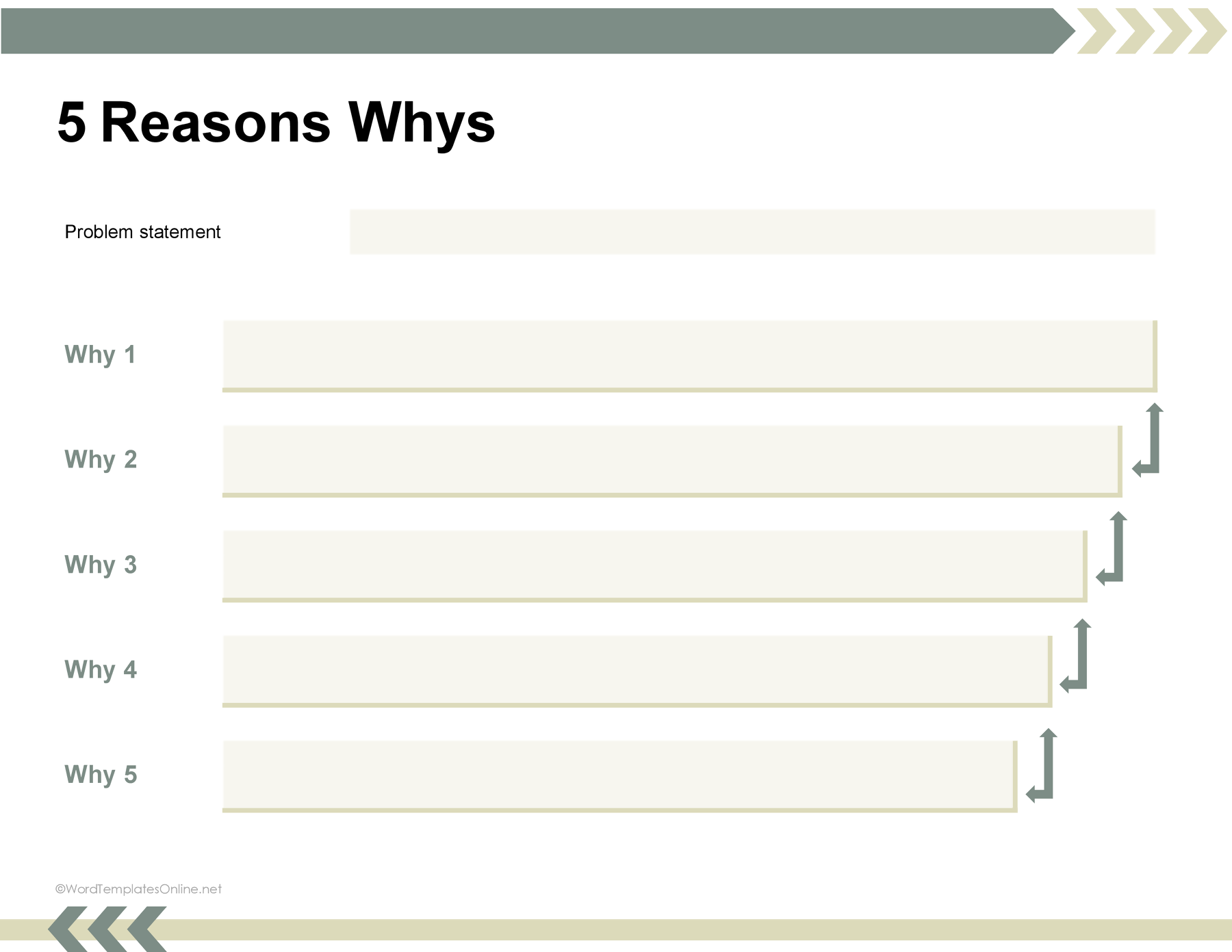
Simple 5 Whys Template
Sometimes, you don’t need a big investigation board with strings going everywhere. A simple 5 Whys template gets straight to the point: write down the problem, work through each “why”, and follow the trail until you reach the root cause. It’s great for quick problem-solving, whether you’re finding things out on your own or brainstorming with a team.
5 Whys Template 03
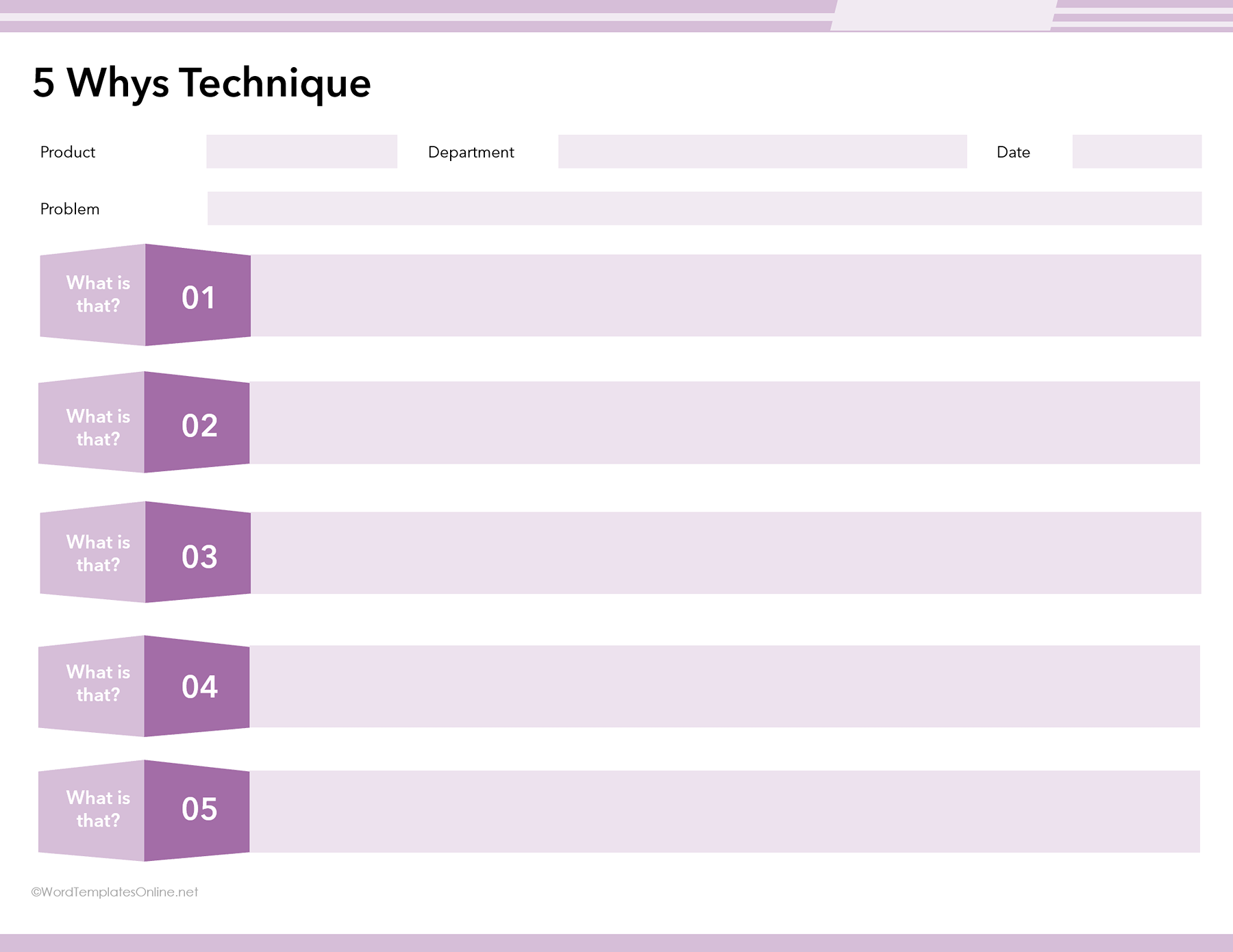
5 Whys Template 01
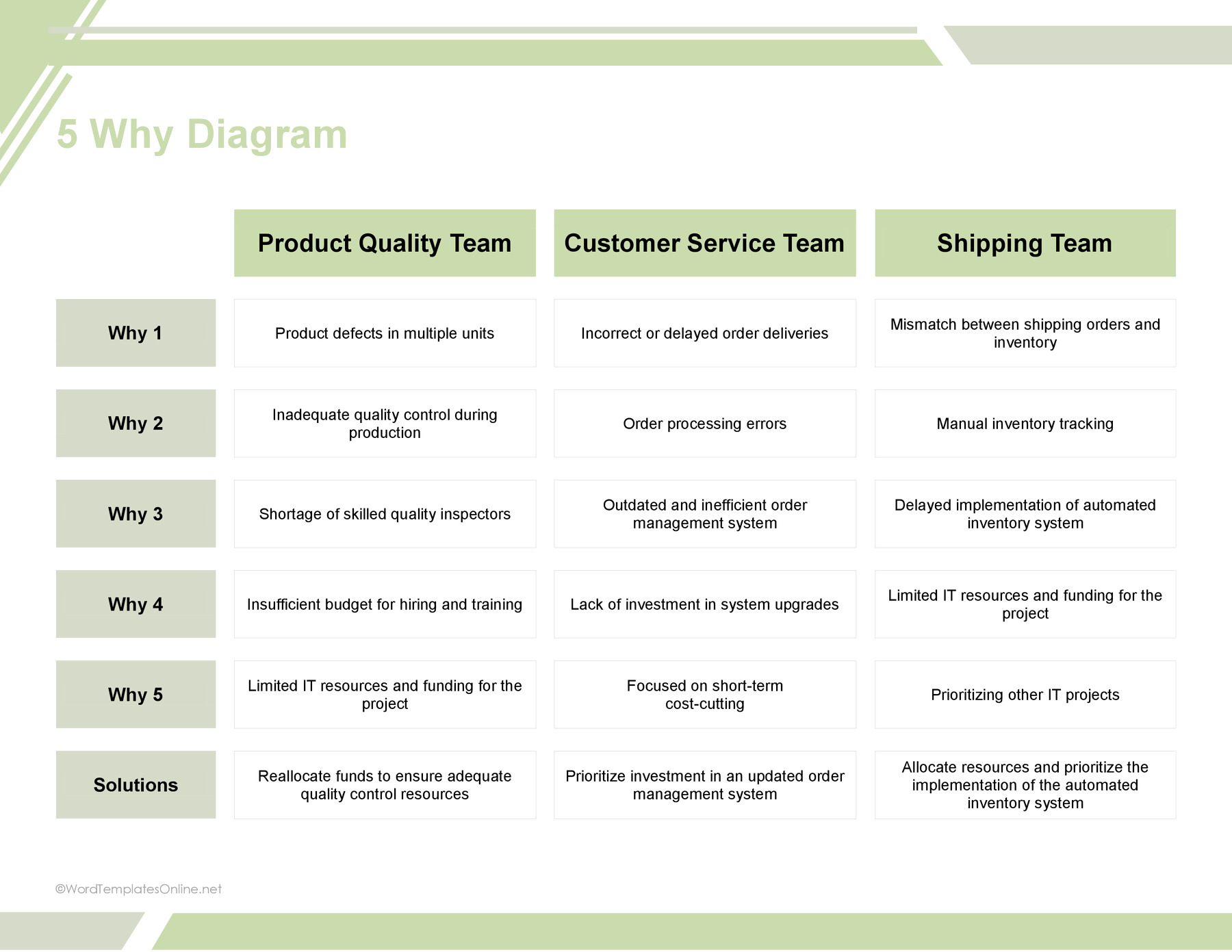
5 Whys Root Cause Analysis Template
This is a more detailed version of a standard 5 Whys worksheet. Instead of analyzing just one problem, it lets multiple teams investigate their own problems side by side. As you can see, it has three columns that track a team’s problem from Why 1 to Why 5.
Once the teams are done with the root cause analysis process, the final solution row turns findings into clear next steps. This layout proves handy for the workplace, quality control, shipping, customer service, and process-related discussions where different teams are dealing with different problems or different pieces of the same bigger problem.
5 Whys Template 02
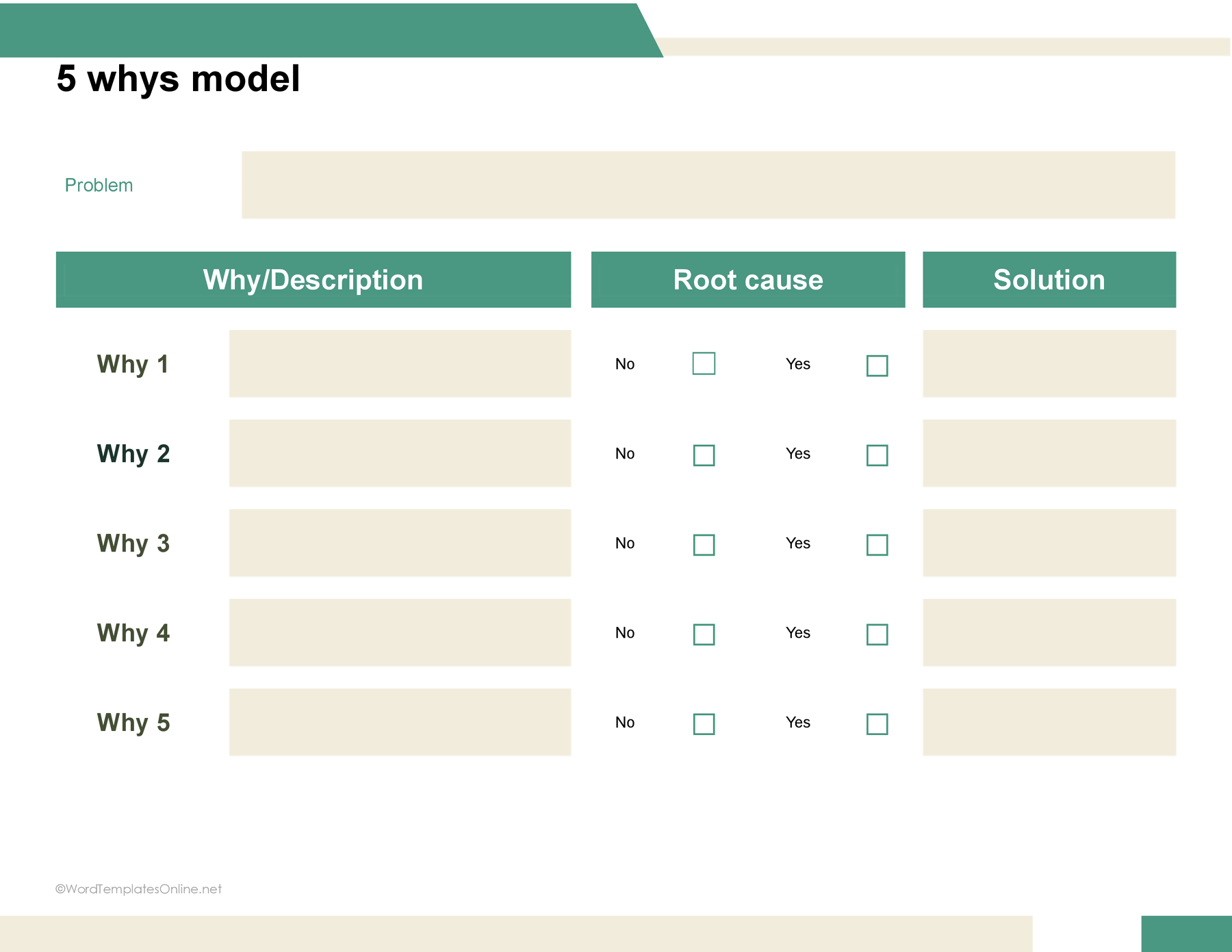
Additionally, if you want to go beyond listing five questions and want to connect each “why” to a root cause check, this root cause analysis template might give you that freedom. The layout starts by giving you a space to write a problem, then gives you five rows for working through Why/Description at each stage.
The most important thing is that for every “why”, you can mark whether the identified cause is actually the root cause. Also, the Solution section gives you room to note what can be done about it.
5 Whys Template 08
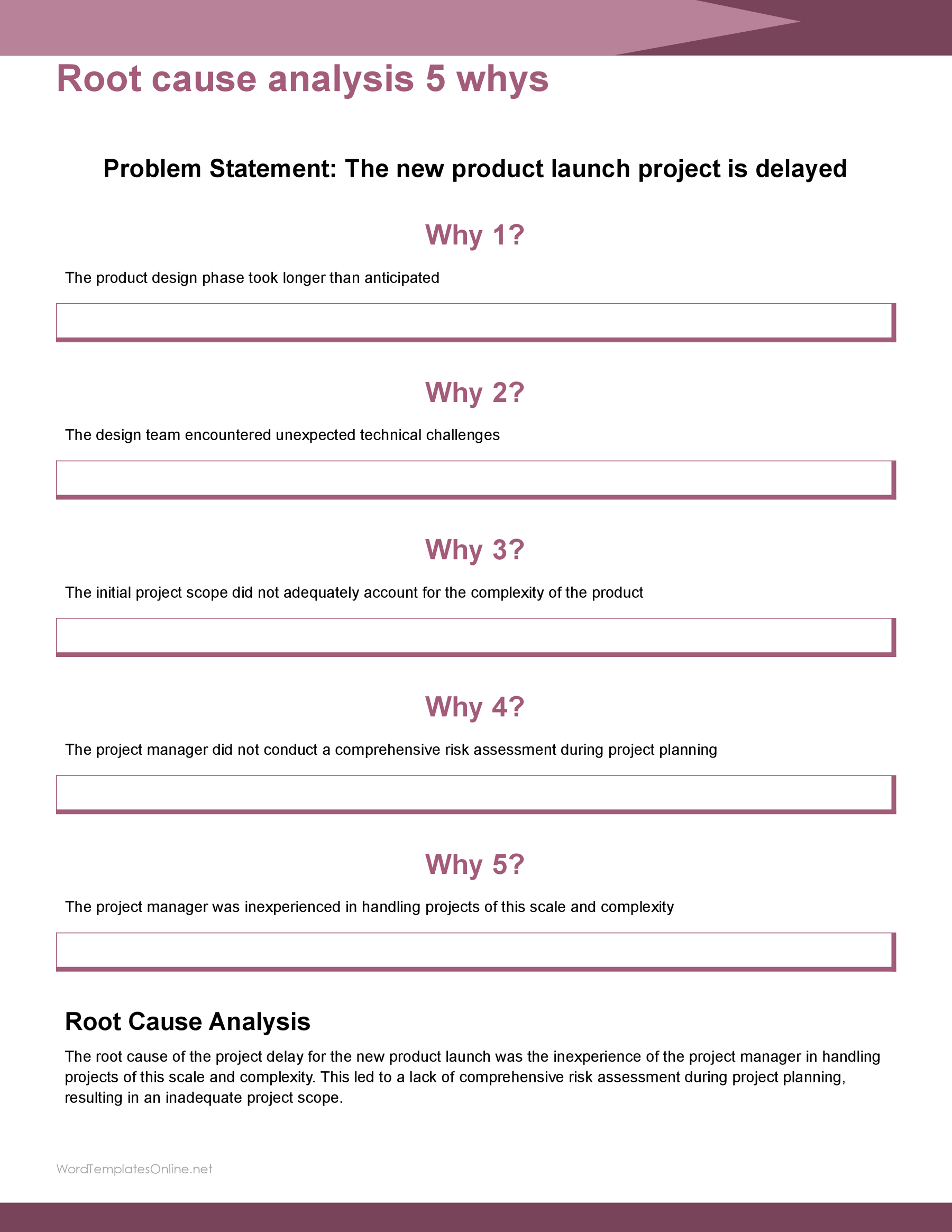
5 Whys Root Cause Analysis Template for Teams
This template shows how this method can turn an overwhelming project delay into a clear chain of causes. Like any other template, it starts by defining the problem statement. After this, you go through each Why from 1 to 5 and explain the possible reasons that are causing the problem.
The Root Cause Analysis at the bottom brings everything together and tells you how different issues led to the final problem.
5 Whys Template 12
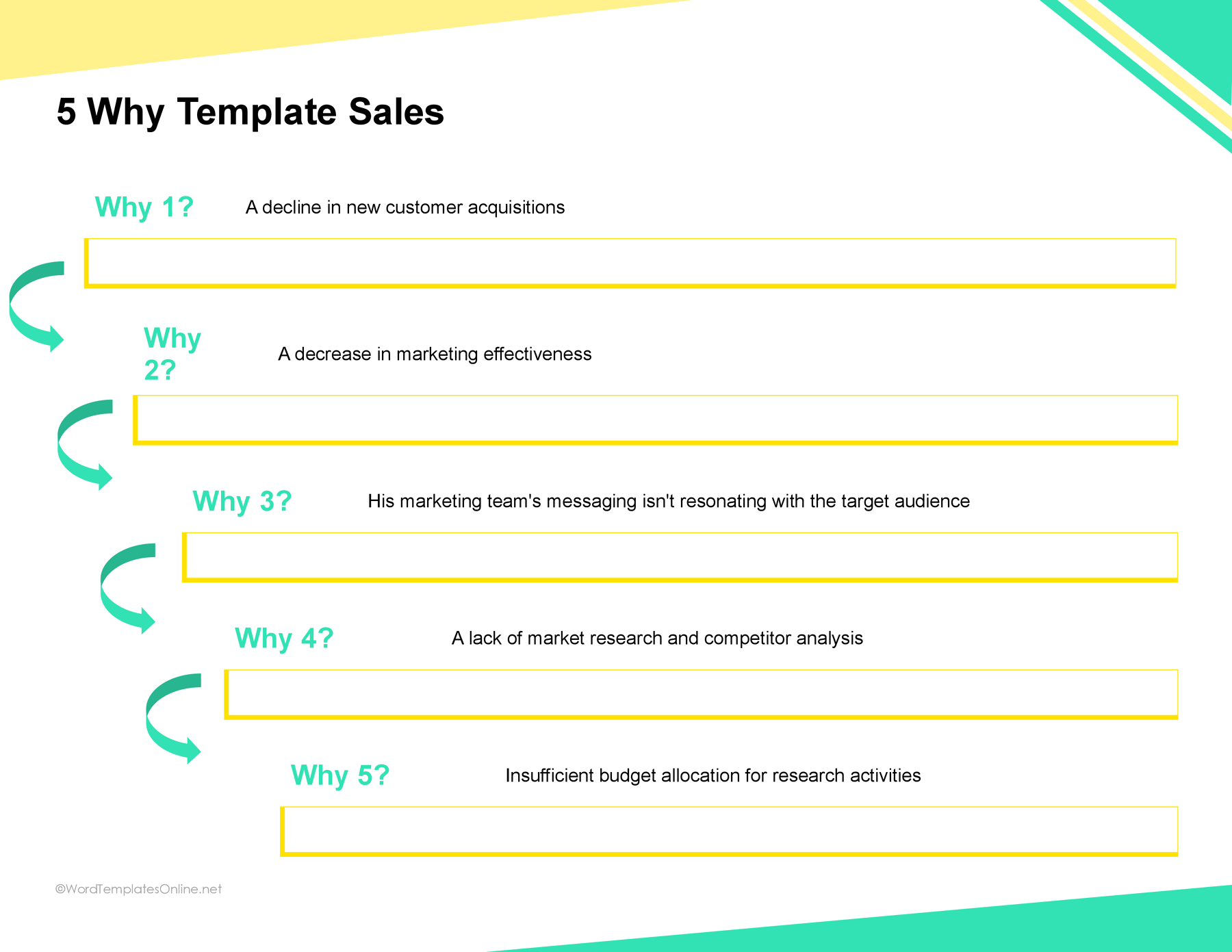
5 Whys Template for Sales
If your sales numbers suddenly take a nosedive, this template literally helps you play detective and skip the guessing game. Starting with the problem statement, it takes you down the problem step by step and digs deeper with each question. In this example, you can see how each reason leads to the next layer, making it easier to spot the underlying issue rather than blaming the sales team or settling for the first obvious answer. Moreover, the blank spaces underneath each question give you room to add your own answers and build a smooth cause-and-effect chain for a sales problem.
5 Whys Template 04
5 Whys Analysis Worksheet
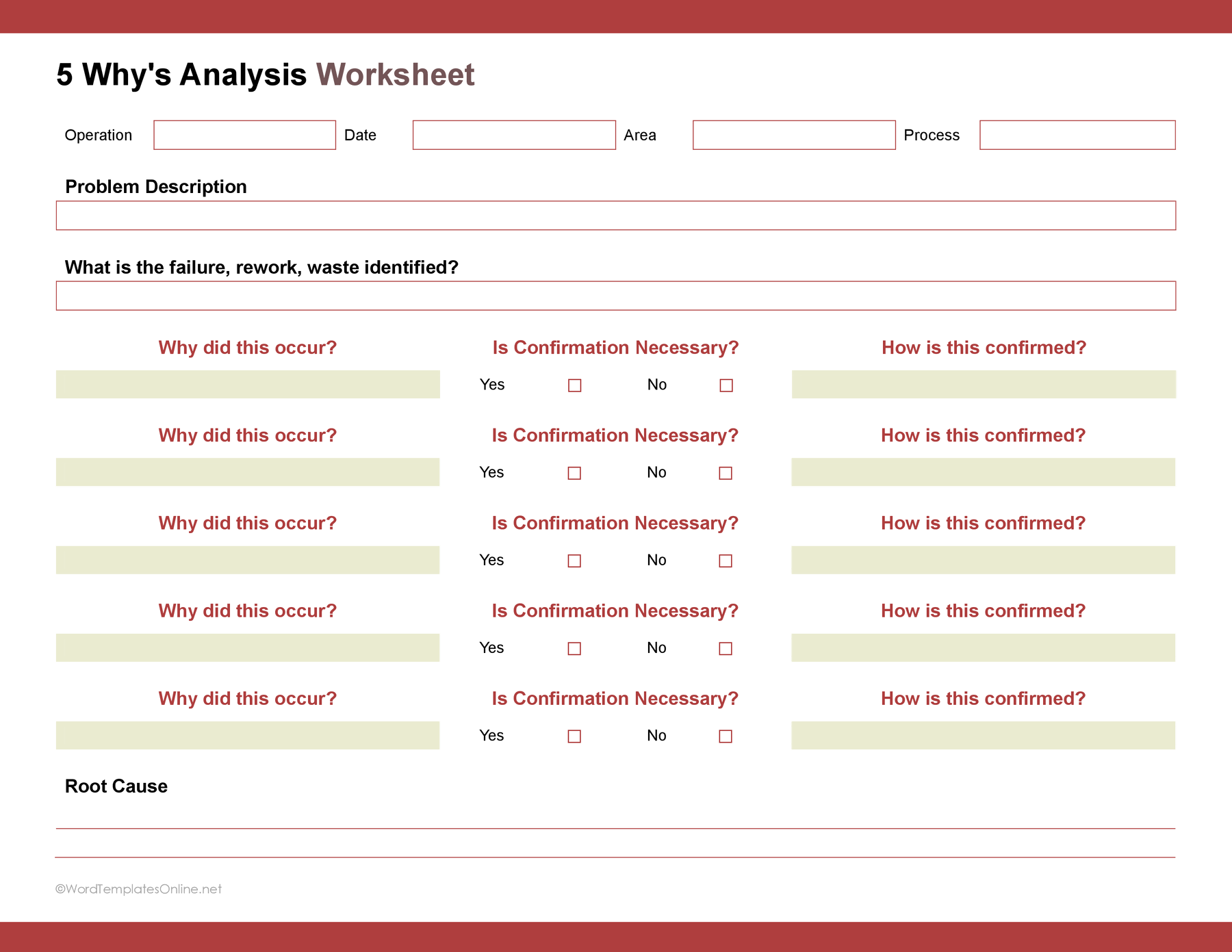
This is basically a worksheet-type template that takes a more structured, evidence-focused approach to root cause analysis. It starts with basic details like operation, date, area, and process, followed by a clear problem description and a place to identify the failure, rework, or waste involved.
From there, you get five rounds of “Why did this occur?” The best part of this template, it does not let you write the answer directly; each round also asks whether confirmation is necessary and how that cause can be confirmed. That extra step is what makes your analysis strong and grounded in facts rather than assumptions.
Moreover, once you have worked with all the Whys, this Root Cause section at the end gives you a place to sum up everything and give the final verdict on what’s really behind the problem.
5 Whys Template 05
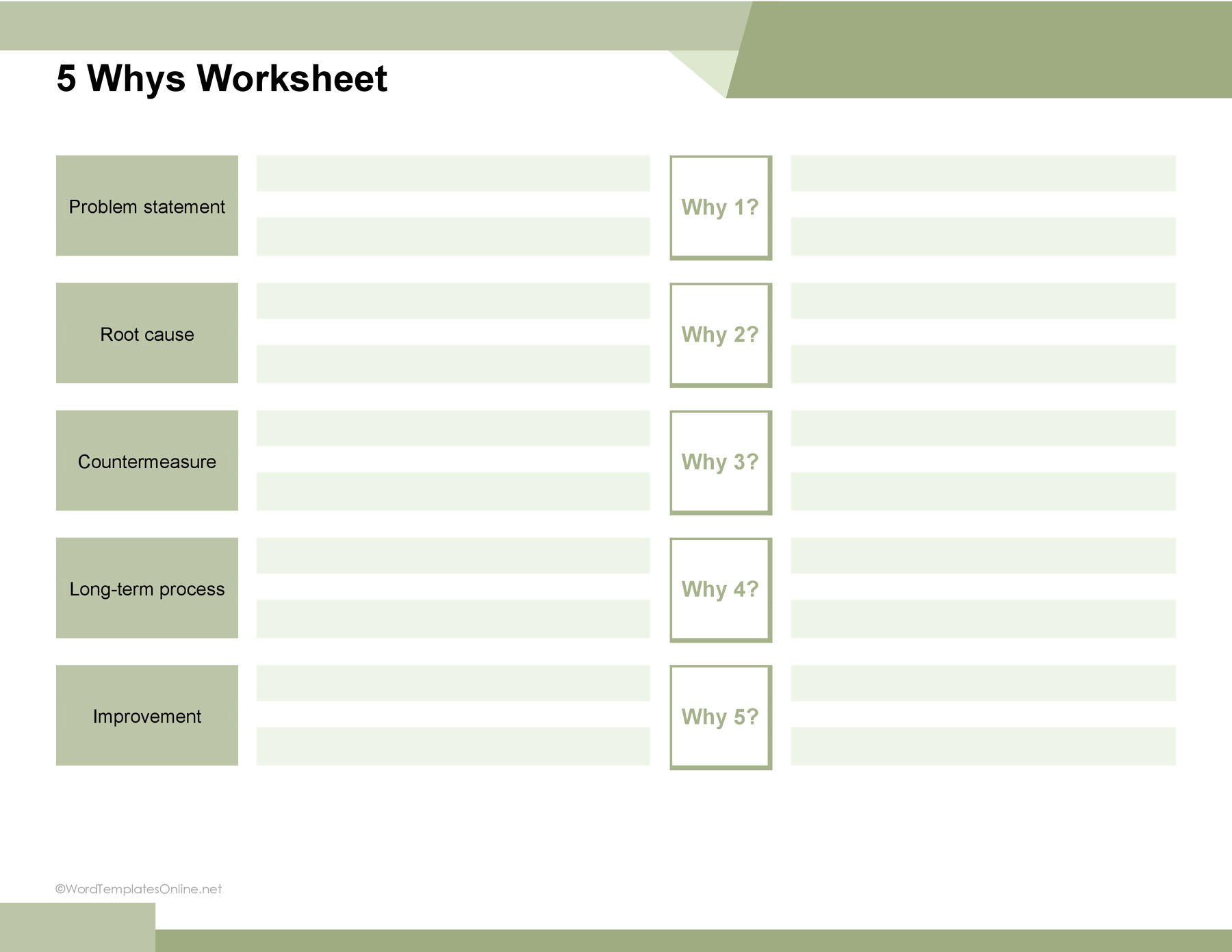
In addition to the above, this 5 Whys worksheet takes a complete approach to problem solving. By filling in the problem statement and then going to each Why, it doesn’t stop at finding the root cause. In fact, it gives you a dedicated section for the countermeasure, long-term process, and improvement, helping turn your findings into real change.
5 Whys Template 11
5 Whys Countermeasure Template
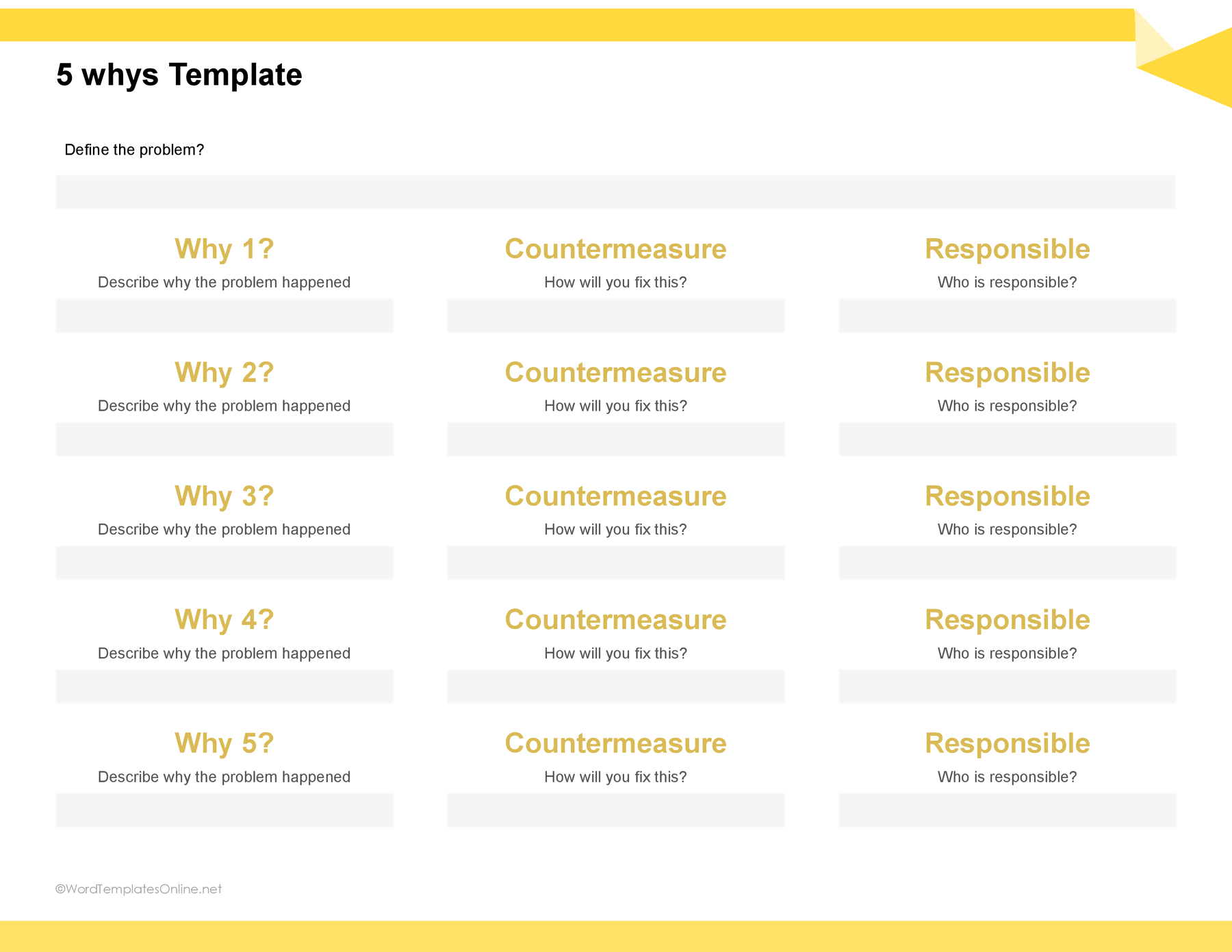
You can refer to this version as the 5 Whys Root Cause Analysis and Corrective Template. Why? Because it doesn’t only help you identify why a problem happened; it also keeps the fix and the person responsible right alongside each step.
Just like the above templates, you will start by defining the problem, then work through Why1 to Why 5, briefly explaining why the issue occurred at this stage. Next to this, you will see there’s a countermeasure section that is for noting how you’ll address that cause and a Responsible section for assigning ownership. In short, instead of ending with, “Well, we found the problem… Now what?”, the template takes you from problem → cause → countermeasure → accountability in one place.
5 Whys Template 10
More Simple 5 Whys Layouts
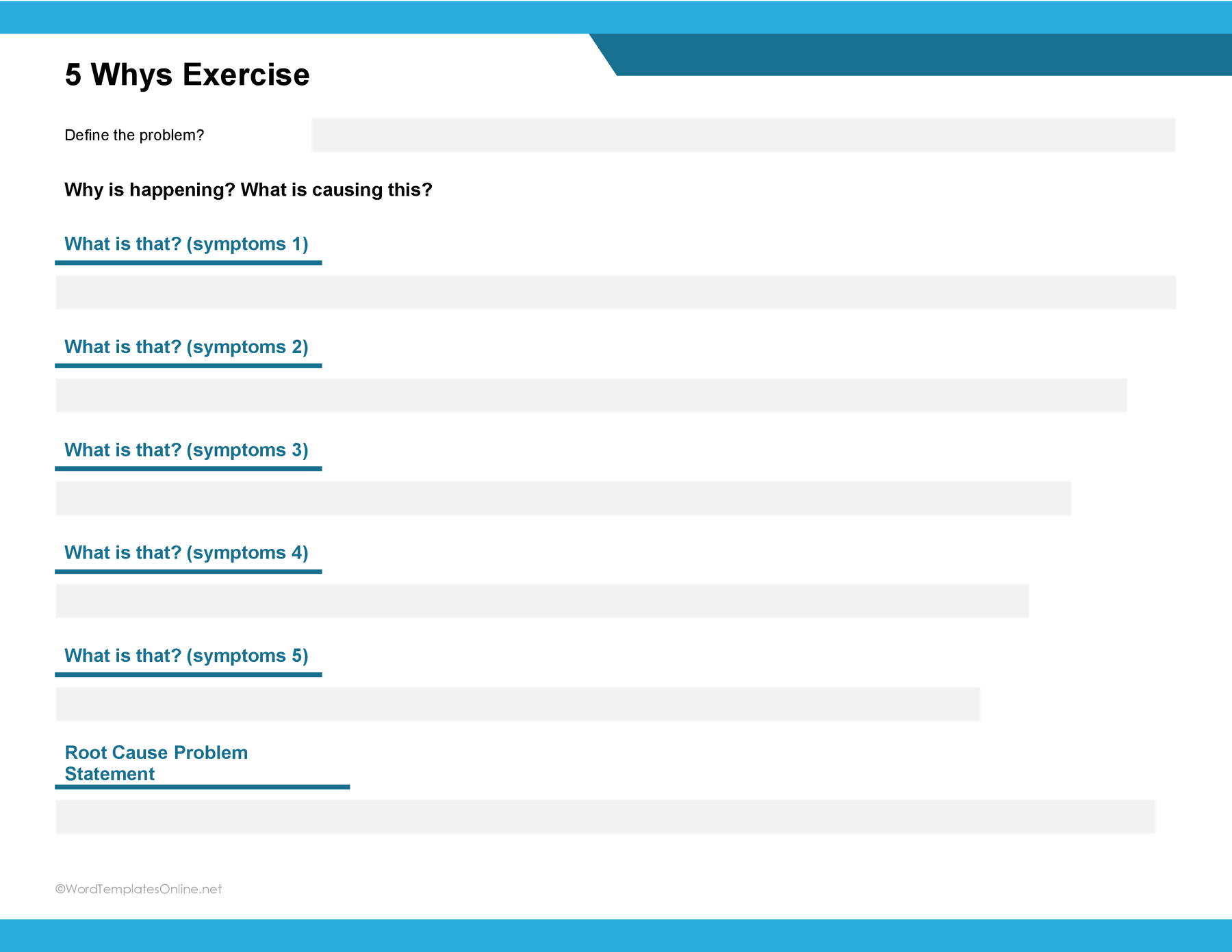
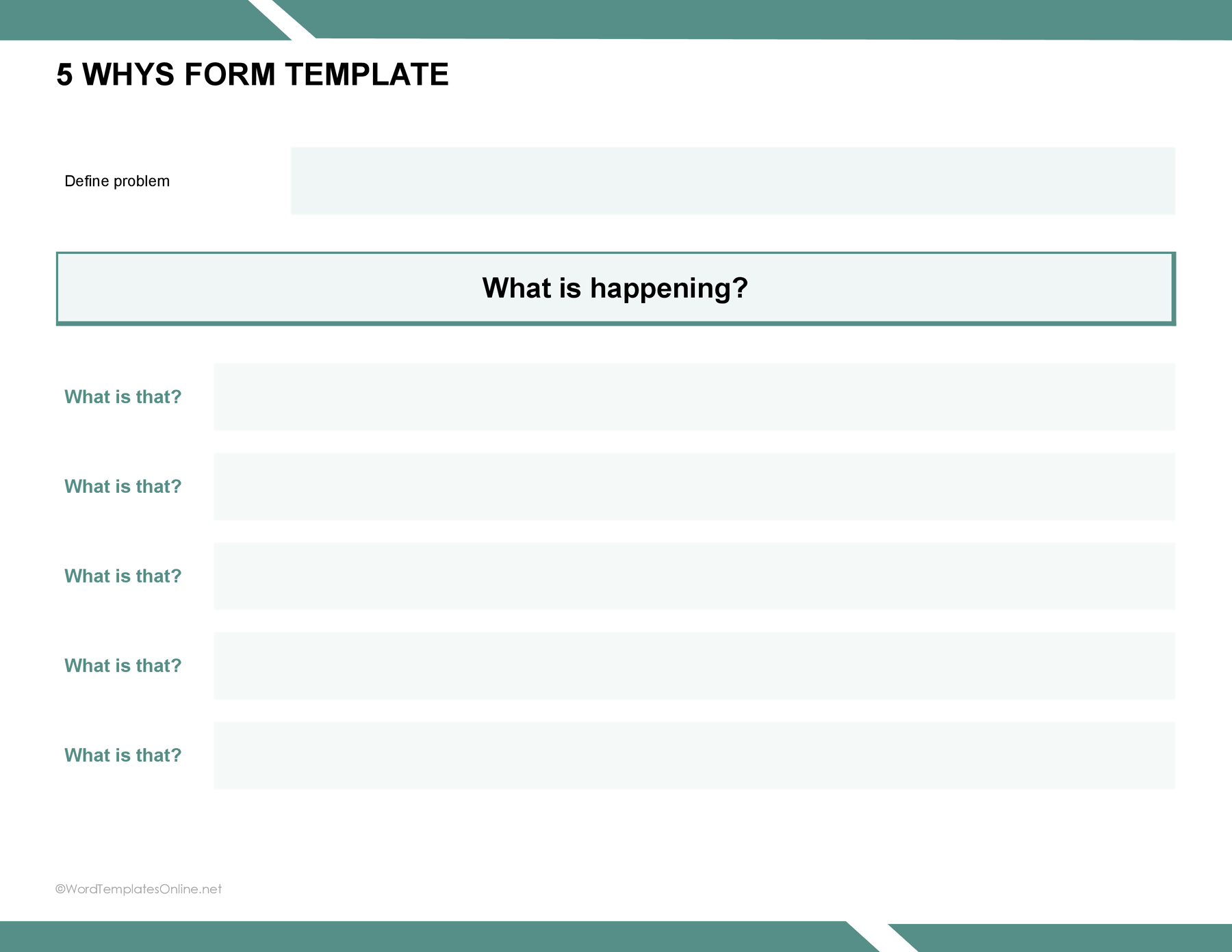
The exercise sheet adds a root-cause problem and solution area beneath the five questions. The form layout uses a prominent “What is happening?” box followed by five “Why is that?” prompts.
5 Whys Template 06
5 Whys Template 07
How to Get Better Results From a 5 Whys Template
You know what? Even with the best templates, things can quickly go off if you don’t use it well. Here’s how you can make the most of the 5 Whys session:
- Write What Happened, Not What You Assumed: Go with the facts, not with what you had heard or thought. Instead of writing “The employee wasn’t careful,” look for what actually happened, such as “The required inspection step was skipped.” Facts give you a clear way to work carefully with something.
- Don’t Turn It into a Blame Game: The analysis is run to find out the actual cause, not to point fingers at each other. Look at the process, systems, communication, or working conditions that may have welcomed the problem to come in the first place.
- Make Each “Why?” Follow the Trail: Make sure each answer leads to the next question. If Why 2 suddenly has nothing to do with Why 1, you’re probably wandering off the trail.
- Don’t Mistake the Symptom for the Cause: Let me clear one thing: a missed deadline, defective product, or unhappy customer is the problem you can see, not necessarily the reason it happened. Keep exploring until you find the underlying cause behind those visible symptoms.
- Don’t Stop at “Aha!”, Do Something With It: Finding the root cause is great, but leaving it sitting in a worksheet isn’t going to fix anything. Turn your results into a solution or preventive action that can reduce the chances of the same problem happening again.
Common 5 Whys Mistakes That Can Throw Off Your Analysis
Before your conclusion, make sure your root cause analysis method doesn’t go down the wrong rabbit hole. Here are some common mistakes to watch out for:
- Starting with a Vague Problem: If you start with something like “The project went badly,” you’re already making it harder for yourself. Get particular with what actually went wrong so your “whys” have a clear starting point.
- Stopping at the First Reasonable Answer: The first answer might seem convincing, but it could only explain the most obvious cause. Don’t stop there; explore other reasons as well.
- Treating Five Like a Magic Number: Remember one thing: you don’t win a prize for asking exactly five whys. Sometimes, the root cause may show up after three questions, or other problems might need more digging. Follow the cause-and-effect trail instead of forcing it to fill five boxes.
Stop Chasing the Symptom: Find the “Why”
Problems have a funny way of coming back when you only fix what’s visible. The 5 Whys method is what makes you slow down, go with the flow, and discover what’s really driving the issue. And with our templates, you can simply start your analysis instead of looking at the blank page and wondering where things will fit. So, check out our template collection and start your 5 WHYs with the one that goes perfectly with your solution.
FAQs
Can I use fewer than five whys?
Yes, absolutely! Five isn’t a magic number. In case you reach a clear, realistic cause after three or four questions, you can stop there.
Can I customize a 5 Whys template?
Of course! You can change the template to match the process, add space for descriptions, or for other needs.
About This Article