We all came across a point in our lives where we feel that life should come with a dashboard. We have trackers for our sleep, spending, and even steps, but we rarely track things that actually fuel us: our connections.
Your life is a network, not a solo mission. But when things get out of hand, it’s hard to tell if your “support system” is backing you or draining you. That’s why we suggest people have an Ecomap.
It acts as a visual snapshot (tree) of a person’s world. With this, you need to have long notes or complicated explanations; you can simply see who’s involved, what kind of relationship exists, and where support (or stress) is coming from.
Thinking of how you’re gonna make it? Don’t worry, we have a solution for this as well. Get our ecomap templates to map out your relations quickly. The best part? You get everything pre-made. Are you ready to stop overthinking your social life and start mapping it?
Where Ecomap Templates Become an Essential Choice
Well, ecomap helps you in places where you wouldn’t expect. First of all, they can be used in social work to get to know a client’s support system. Moreover, they can bring a huge benefit in nursing to get a clear picture of a patient’s environment and care needs.
If you’re a therapist or counselor, you can use these templates to map out relationships and emotional connections. In education, they help students track student support systems both in and outside school. Most importantly, on a personal level, it is very important. You can use it to get a better understanding of your family dynamics and simply know who’s connected to you and how.
What to Look for in a Comprehensive Ecomap Template
An ecomap might seem simple, but it has some key elements that make the whole thing work. Let’s find out:
1. It has central individual or family unit
Every template has this basic point in which you add the main person or relation you’re focusing on. Usually, it comes right in the center, just like a hub, because everything else connects back to it.
2. It shows the external system and connections
The second most important thing is the related system. Around the center, you’ll add all the important parts of a person’s life, such as family, friends, school, work, or community groups. These are basically the systems people interact with daily, and they give you a complete picture of their environment.
3. It illustrates relationship lines and their meeting
This is where things get interesting. Most templates have these lines that connect the center to each system and show the type of relationship, whether it’s strong, weak, stressful, or even broken. Through this, you can instantly understand how supportive (or challenging) each connection is.
4. It suggests flow of resources and energy
Moreover, some templates also have arrows that are used to show the direction of support, stress, or influence. For instance, is support coming towards the person, or are they giving more? These small details help you carefully analyze the dynamics of a particular relationship at a glance.
Different Types of Ecomap Templates You Can Use (Free & Easily Editable)
Not all ecomap templates are used in all situations. For this purpose, we’ve come up with different types of templates that you can use in a relevant situation.
Template 1: Ecomap nursing
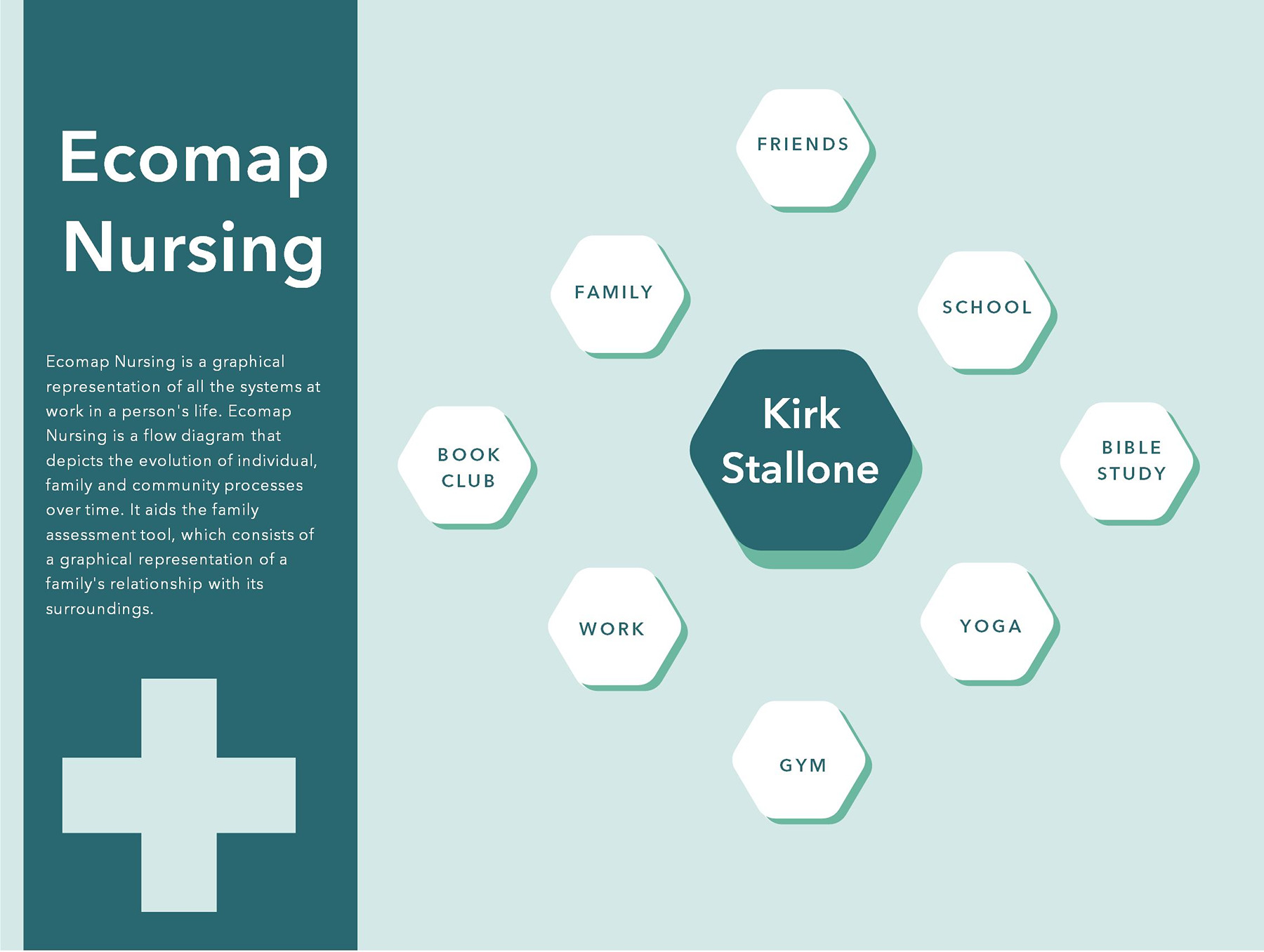
This is a basic template that comes with a “hub” where you add the main person (Let’s say, Emma Watson). Around her, you will include the different parts of her life, such as family, school, friends, work, gym, and other activities.
This template is quite useful in social work or nursing settings where you instantly see the patient’s world at a glance.
Template 2: Ecomap nursing portrait
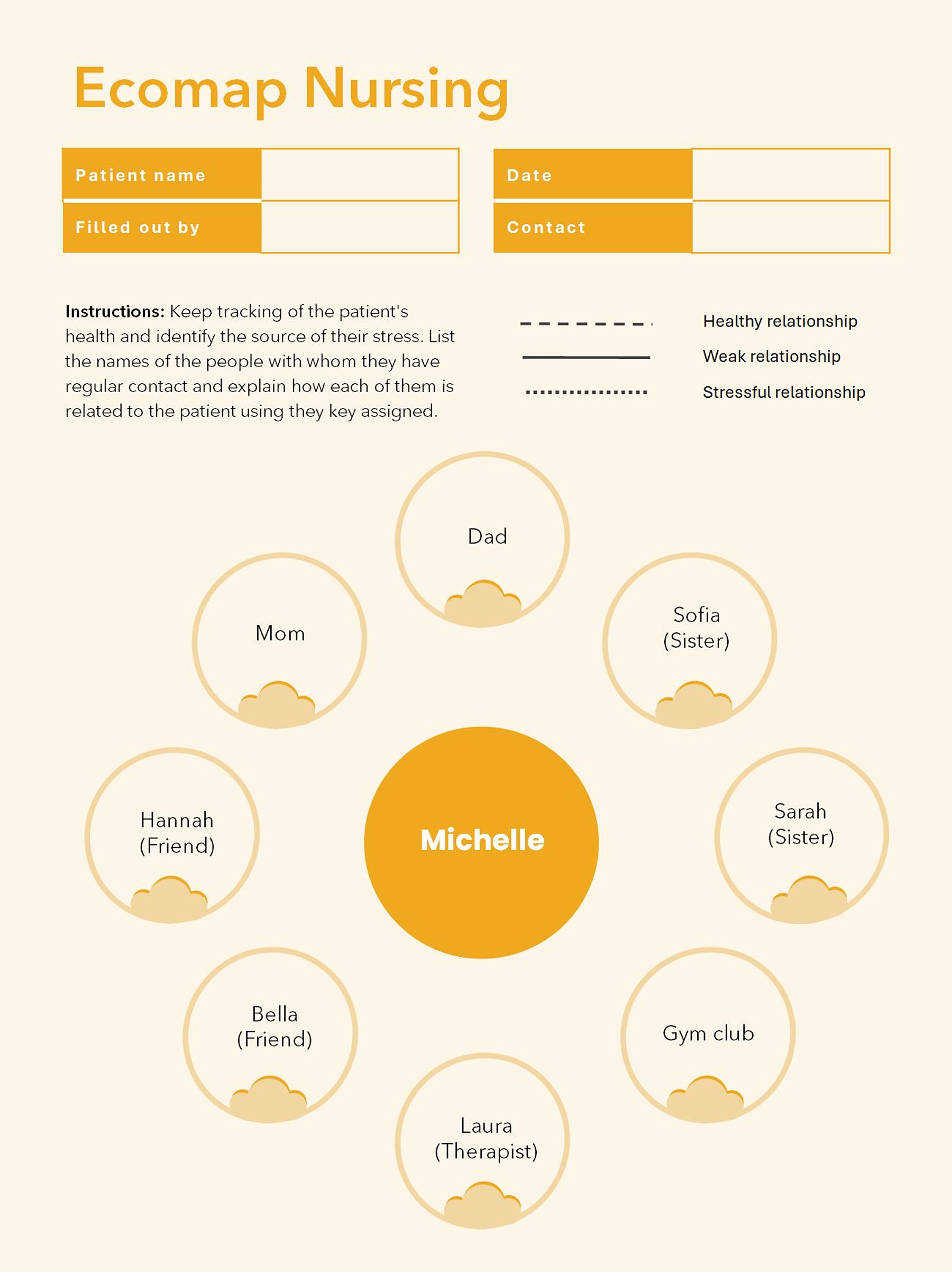
It is a more detailed tool for mapping out a patient’s social health and identifying who is causing the stress. As you can see, you will add the patient’s name at the center, which will be surrounded by specific individuals and groups.
- Unlike the simple one, it uses the distinct relationship lines (dashed for healthy, solid for weak, and dotted for stressful) to visually represent the nature of each connection.
- Additionally, it also includes a clinical utility where you can enter basic information such as the patient’s name, date, and the clinical contact info. It is great for record-keeping and history.
- Overall, this template gives you a holistic overview of patient support or conflict by mapping relations.
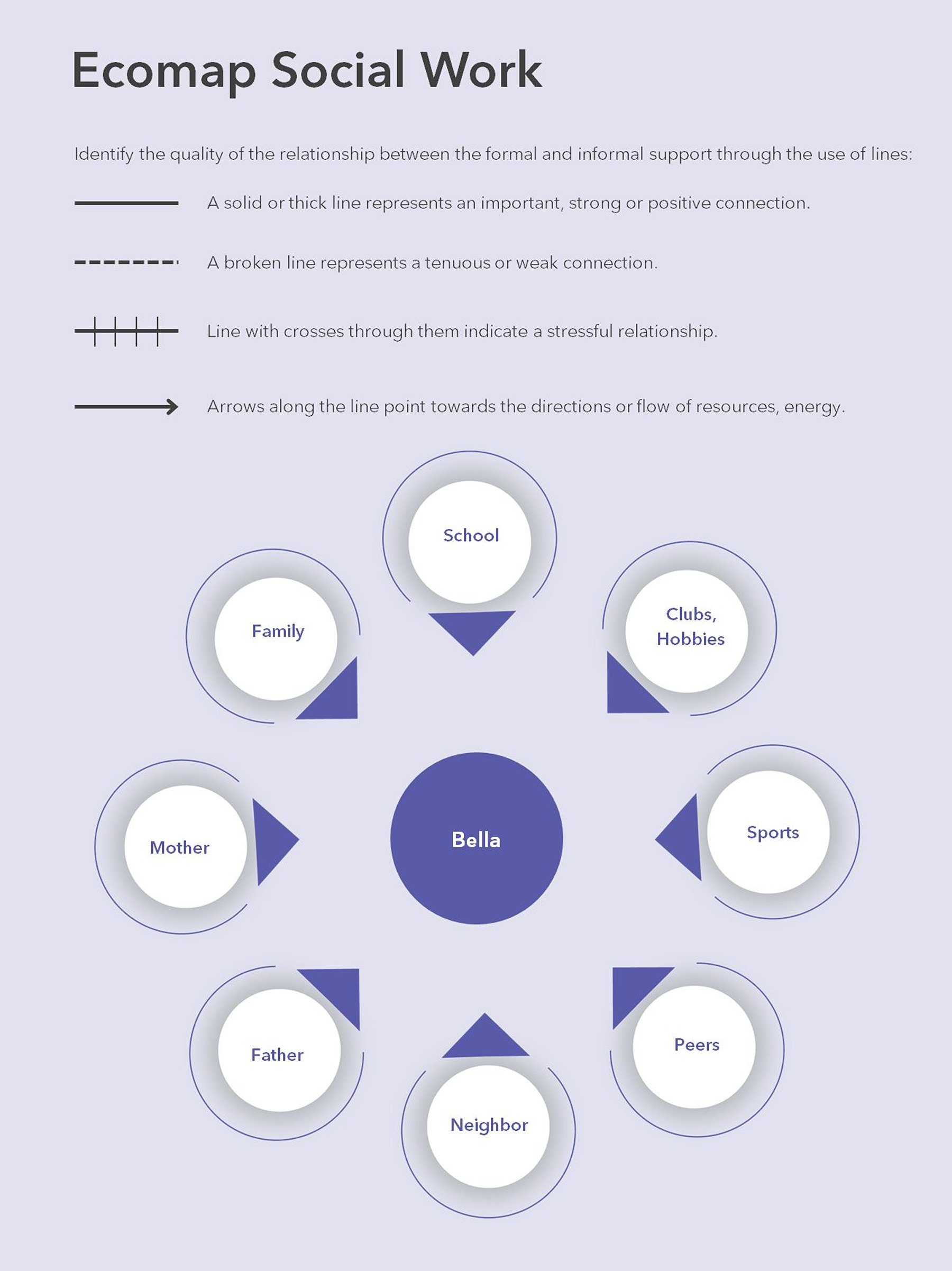
Template 3: Social work ecomap
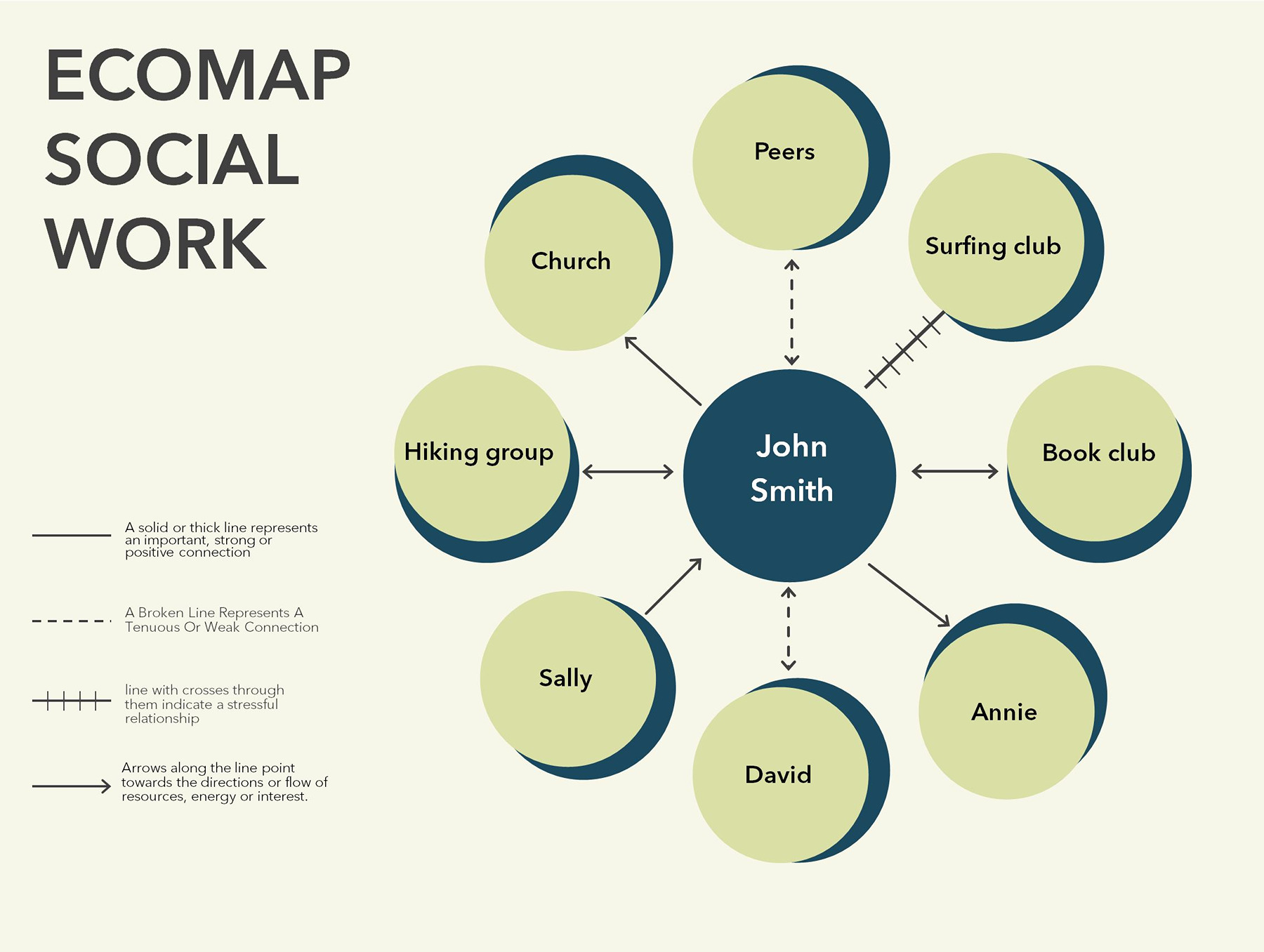
This layout is best fit for a person who wants to dig deep into their social world. For instance, as you can see, the map uses specific symbols to visualize how energy and resources flow between a person and his community. By using arrows/relationship lines, you can indicate the “direction” of support and chaotic connections. Through this, it is easy to pinpoint which areas of someone’s life are draining them versus where they are thriving.
Note: The concept of lines is the same as we explained in the above template.
Ecomap Social Work Landscape
Ecomap Social Work Portrait
Template 4: Family ecomap
Family Ecomap Landscape
Family Ecomap portrait
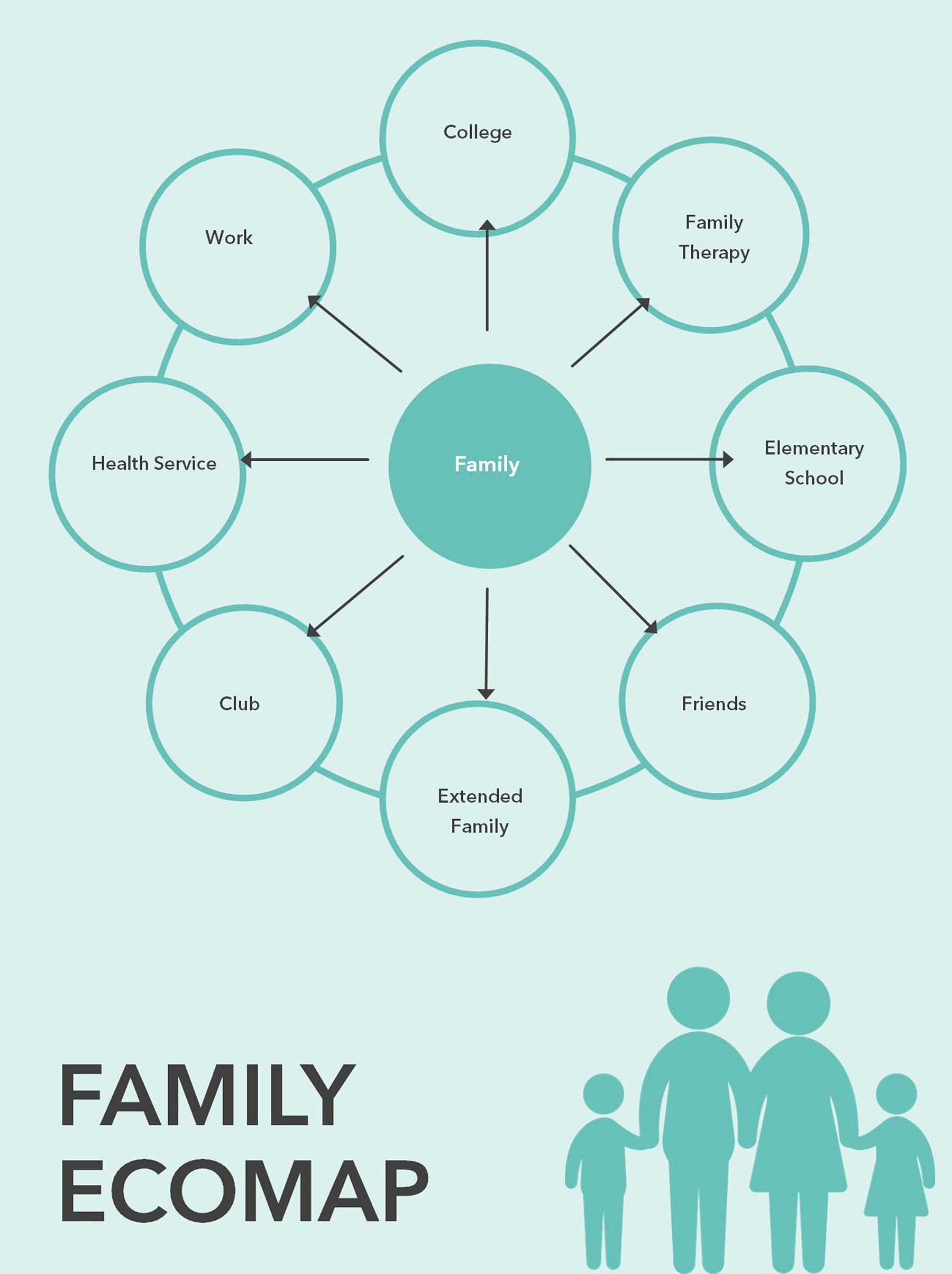
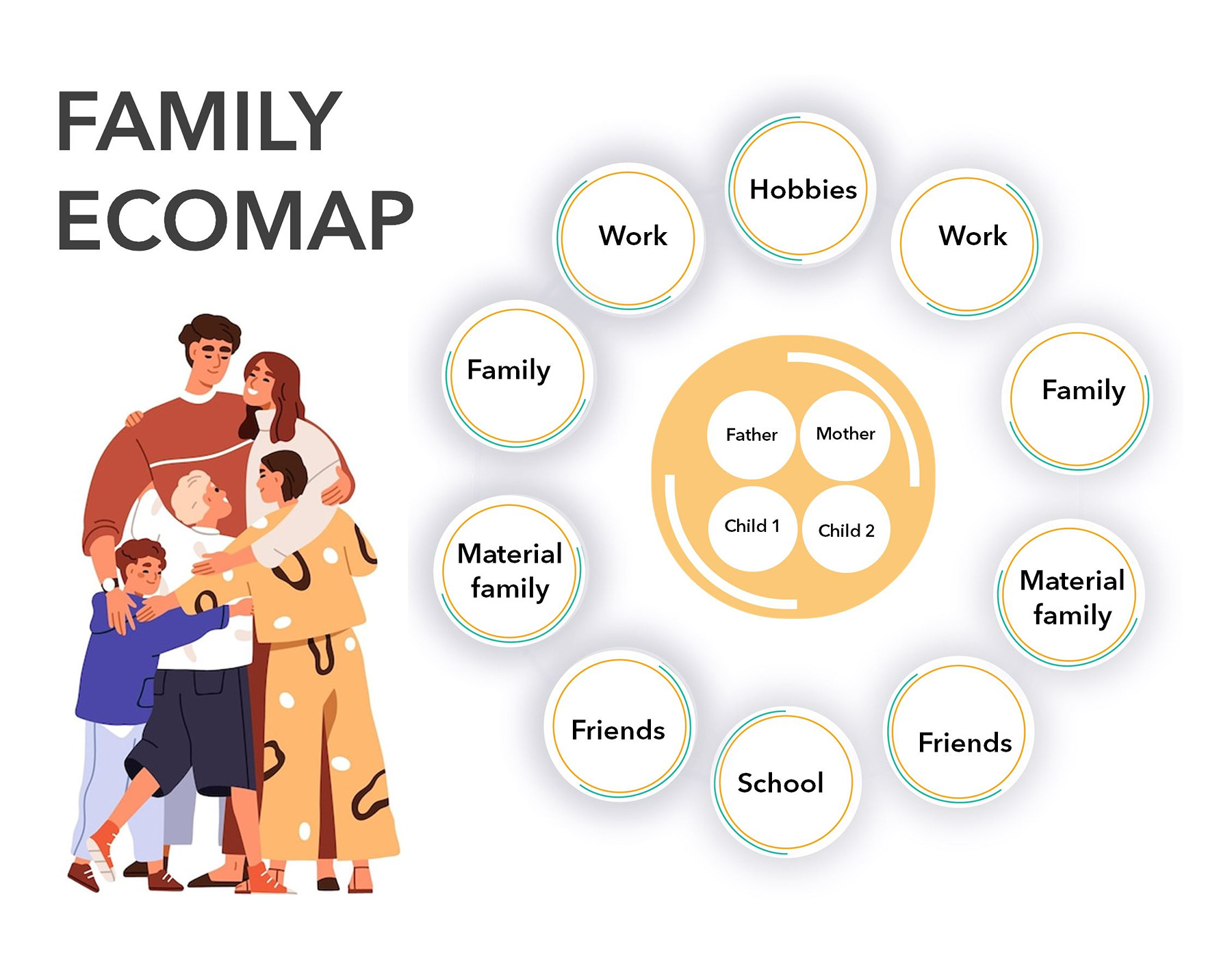
This layout is for looking at family connections. It takes a broader look at the household as a whole, placing the complete family (children, parents) at the center of the diagram. Basically, this layout shows how the family works as a unit with external systems like work, school, and even hobbies.
Mainly, by mapping out different shared connections, you can see if the family is well-integrated into the community or being isolated. Overall, it’s an amazing tool for seeing how external pressures on one person might be rippling through the rest of the family.
How to read and interpret an ecomap
These maps aren’t complicated, but how you read them tells a whole story. Interpreting them accurately is important because it tells you patterns in someone’s life.
- Reading the ecomap is really simple. Start by understanding the connections. See which areas (family, work, friends) are closest or most active around the person. Through this, you can easily get the idea of what’s really important in their daily life.
- Next, you need to figure out support systems vs stressors. The connections that bring positive energy are support, while the ones that weaken or tense someone’s life are stress or challenges.
- The next step is to look for the gaps. Are there any missing areas, like no social circle or community support? These gaps can assist you in finding out where help is needed.
- Once you gather all the insights, it’s time to make decisions. Whether it’s in healthcare, social work, or personal use, this map is the best way to check what’s working, what’s not, and what needs attention.
How to Customize an Ecomap Template for Your Needs
You can use the above templates in any case scenario. All it takes few tweaks and there you go:
Step 1: Adjust labels and categories
The templates generally come with the generic labels and categories, so you can edit them easily to match your situation. If you want to add things like school, healthcare, or other areas, depending on what’s relevant, you can use Google Slides or PowerPoint format.
Step 2: Add or remove connection types
It totally depends on you how detailed you want to go. For a broader view, you can include different types of relationships. Whereas, if you want to keep it simple, you can focus on important relationships and remove the extras.
Step 3: Use colors for clarity
Using colors makes the map easier to read. The purpose here is not to make the template fancier, but to easily find out where things are going wrong, such as green for strong support and red for stressful connections.
Step 4: Adapt it to your field
These templates are not set in stone. You can tweak it based on purpose or needs, e.g., social work, nursing, or personal use. If your desired fields are already there, then it’s a cherry on top.
What Not to Do When Creating an Ecomap
If you’re not careful, you can easily overdo a map. Here are some common mistakes that you need to be aware of:
Overcrowding the diagram
- The Challenge: We think that fitting everything will help our map, but it is not the case; it usually makes it messier and harder to read.
- The Fix: Make sure to only stick to the relevant areas and add only those relationships that matter.
Mislabeling relationship
- The Challenge: Other mistakes that we often make are labeling wrong connections. This might seem like a small thing, but it can mess up the whole meaning.
- The Fix: Look carefully and then show whether a relationship is strong or weak.
Ignoring the direction of influence
- The Challenge: If you think that those arrows are just for show, then you’re wrong. Skipping them means you’ve missed the important context.
- The Fix: Well, they tell you who’s giving or getting support, so always illustrate them accurately.
Adding unwanted complexity
- The Challenge: Using too many lines of style and symbols can confuse the map and bring confusion.
- The Fix: Always stick to one style. If everything looks different, it’s harder to follow.
Not updating the map
- The Challenge: Some practitioners or individuals update the map once in a blue moon. Things change: relationships, support systems, and situations may evolve.
- The Fix: The best approach is to update the ecomap regularly so it stays accurate and consistent.
Conclusion
At the end of the day, ecomap is not about just mapping relationships with a perfect diagram, but it is about how these relations actually work in real life. With this, you can easily identify which part of your life is draining you and which areas are positively pushing you.
Moreover, the interesting part is that you don’t have to make the map by yourself. Our templates are here to help. Think of them as your ultimate shortcut, as they’ve done the heavy lifting by giving you a pre-made structure. Just plug in the details and connections, and that’s it. However, keep it simple and real to make the most out of it.
Frequently Asked Questions
How detailed should an ecomap be?
There is no specific rule on how detailed it should be. For professional work, it should cover in-depth information. Whereas if you’re using it for personal use, you can keep it simple.
Are ecomap templates suitable for beginners?
Yes, perfectly! If you’re a beginner, don’t worry, you can easily use them as they give you a clear format to follow.
Can I edit the templates?
Of course! These templates come in editable format (Google Slides & PowerPoint), which makes editing a breeze.
About This Article