Most people think that research posters are the “shrunk-down version” of a research paper, but that’s not even close. A good poster isn’t something about summarizing what you have done; it’s about showing only the right things that can help understand what you’re doing in a few seconds.
Whether it’s about a conference, classroom, or professional setting, your poster is often your first impression. Honestly, attention spans are short, and if you can’t catch attention in a few seconds, people will walk past. For such situations, templates matter a lot. You don’t need to stare at a blank page thinking where to put the title, hypotheses, and results; a reliable template gives you a clear layout to work with.
In this guide, we’ll explore different types of templates, how they work, and how to choose one that fits your research and audience. So, let’s go!
The Role of Research Posters in Modern Academia
Even though the world relies on PDFs, slides, and online journals, research posters are still the unmatchable winner. Why? Because they’re fast, interactive, and built for people on the move.
Let’s face it: life is busy, and most people aren’t going to sit down to read your 20-page research paper. That’s why a better-designed poster is always a go-to option, so that people know what you’re working on in under a minute.
Moreover, posters are a really good option when you need to start a conversation. It shines in conferences as they let people walk up, look at your work, and ask questions on the spot. At the same time, in classrooms, they make presentations less formal and more interactive. Not only that, you can use them in internal reviews or team meetings because they help simplify complex ideas so that everyone remains on the same page quickly.
What makes a research poster template “effective”?
Well, the “effective” doesn’t mean a template looking good; it’s about making your content easy to follow. You need a layout that takes your reader naturally from one section to the next without any confusion. If someone has to figure out where to look, what’s the point of a PERFECT template?
Plus, eyes attract great visuals, and templates give you a clean, balanced design that allows people to stay engaged and actually remember what they saw. Good templates don’t encourage clutter but give very limited space that can make only key points stand out.
Anatomy of a High-Performing Research Poster
If you think that a poster is all about “condensing a research paper” and adding all the sections, you don’t get the idea. It covers some important sections that convey the main idea. Each part has a job to do, and when all work together, your poster actually makes an impact.
1. Title section
One of the first things your reader will notice. So when you come into a write-up, think of it as your only chance to grab someone’s attention. You don’t need to make it hard and lengthy; it needs to be snappy, sharp, and easy to read, even when people are skimming from across the room.
2. Author & affiliation details
Almost all templates come with a space at the top where you can write your name, institution, and any collaboration. The section is put here because it adds credibility to your work. No need to fancy it, just make sure it’s visible and professional enough.
3. Abstract or introduction
This is the part where things become interesting. Most of the time, people overdo this section. Think of this section as your “big picture” overview, basically telling your reader what this research is about and why it matters.
Whatever you do, don’t write it like a dry, boring research paper! Just write a few punchy lines enough to give readers a main idea without digging in deep.
4. Hypotheses (optional)
Though it is important in most of the research, like medical, it is not a universal section that comes in every template. This section is all about prediction and what you will achieve in the end. It is written down with the famous “if-then” statements.
4. Methodology
It is basically a “how-to” section of your poster. In this part, you will remove the curtain that shows people how you did the brilliant work. Sometimes, we overlook this section, but it is what connects your title to the main findings. If possible, you can show the methodological part in a flowchart or step-by-step process that makes everyone grasp it easily.
5. Results & findings
Well, results are the heart of any project. In this section, you show off your data. If it’s come out in quantitative measures, you can use graphs or tables to tell the story. However, for the qualitative things, you can explain using “positive or negative”, “yes or no” statements. Remember: don’t add everything you found, just highlight the “wow” results that actually matter.
6. Discussion & conclusion
This part is all about telling your reader what your finding means in the real world. One thing you need to take care of is to discuss your results explicitly, whether they supported previous research or not. Moreover, it should be concluded in a way that lets people remember it after they walk away.
7. References & acknowledgment
Some templates cater to this section, while some do not. Here, you give a shout-out to your sources and anyone who helped you in your research. Don’t tuck away citations so that they spread all over the space; keep it neat.
Field-Specific Research Poster Templates (Because No Template is One Size Fits All)
Different fields or subjects have specific criteria for making a poster, which is why you cannot use a generic one for all options. Here, we try to make your life a little easier by giving field-specific templates. Let’s find out how they work:
1. Medical & clinical research poster
Medical Research Poster Template
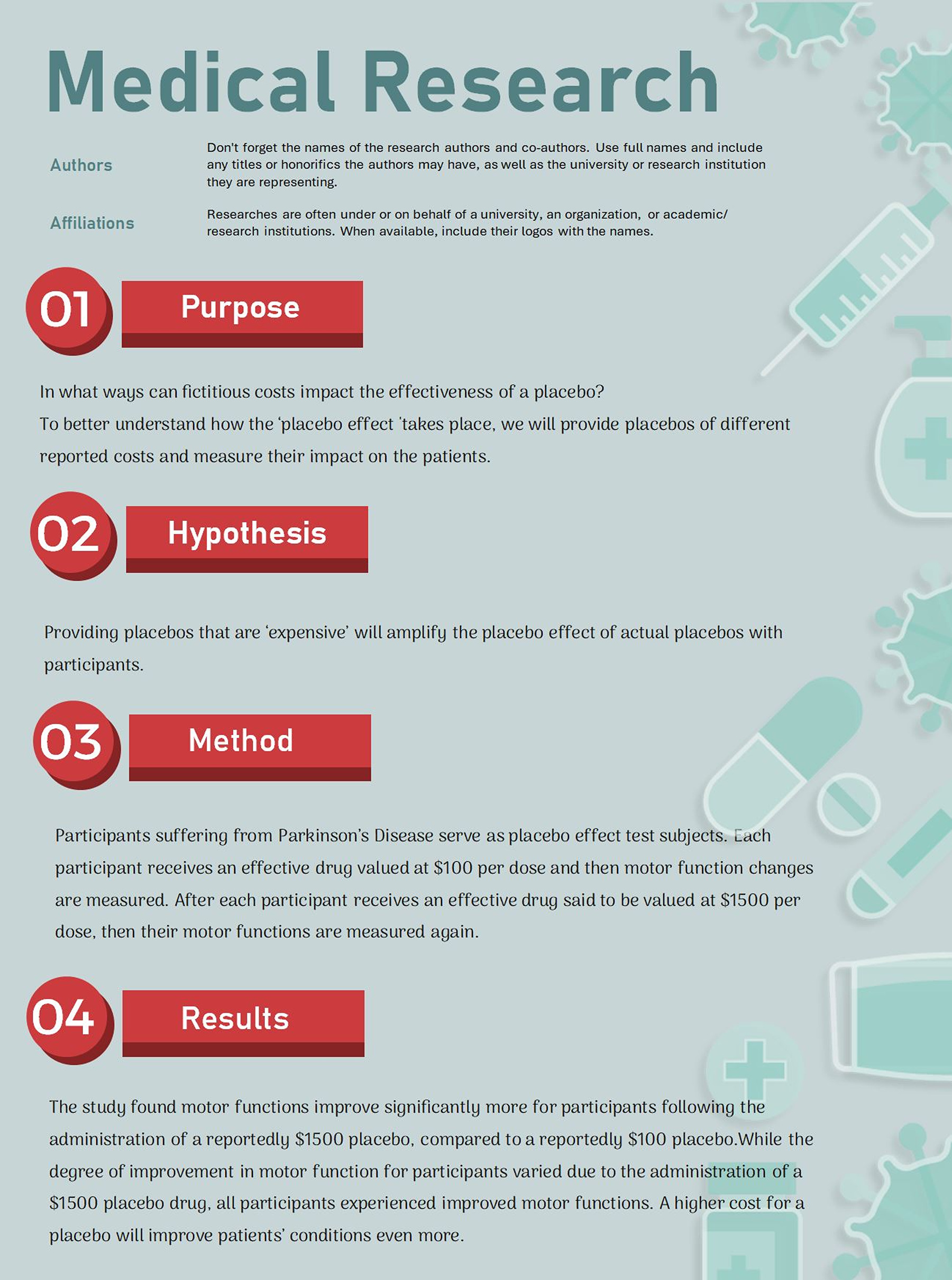
Medical Research Poster Template
The template is the ultimate “cheat sheet” for turning a complex medical study into something easy that people can understand. It ditches the lengthy wall of text for a super clean, vertical layout that follows a strong hierarchy and holds the reader’s hand from start to finish.
Starting from the top, you will add the authors and affliction details. Then, coming toward the main section, the template covers primary sections (purpose, hypotheses, method, results), where you need to write minimal yet important details. Overall, it’s perfect for those busy conferences, where you have a lot to say but only 60 seconds to grab someone’s attention.
2. Engineering & technical poster
Engineering Research Poster Template
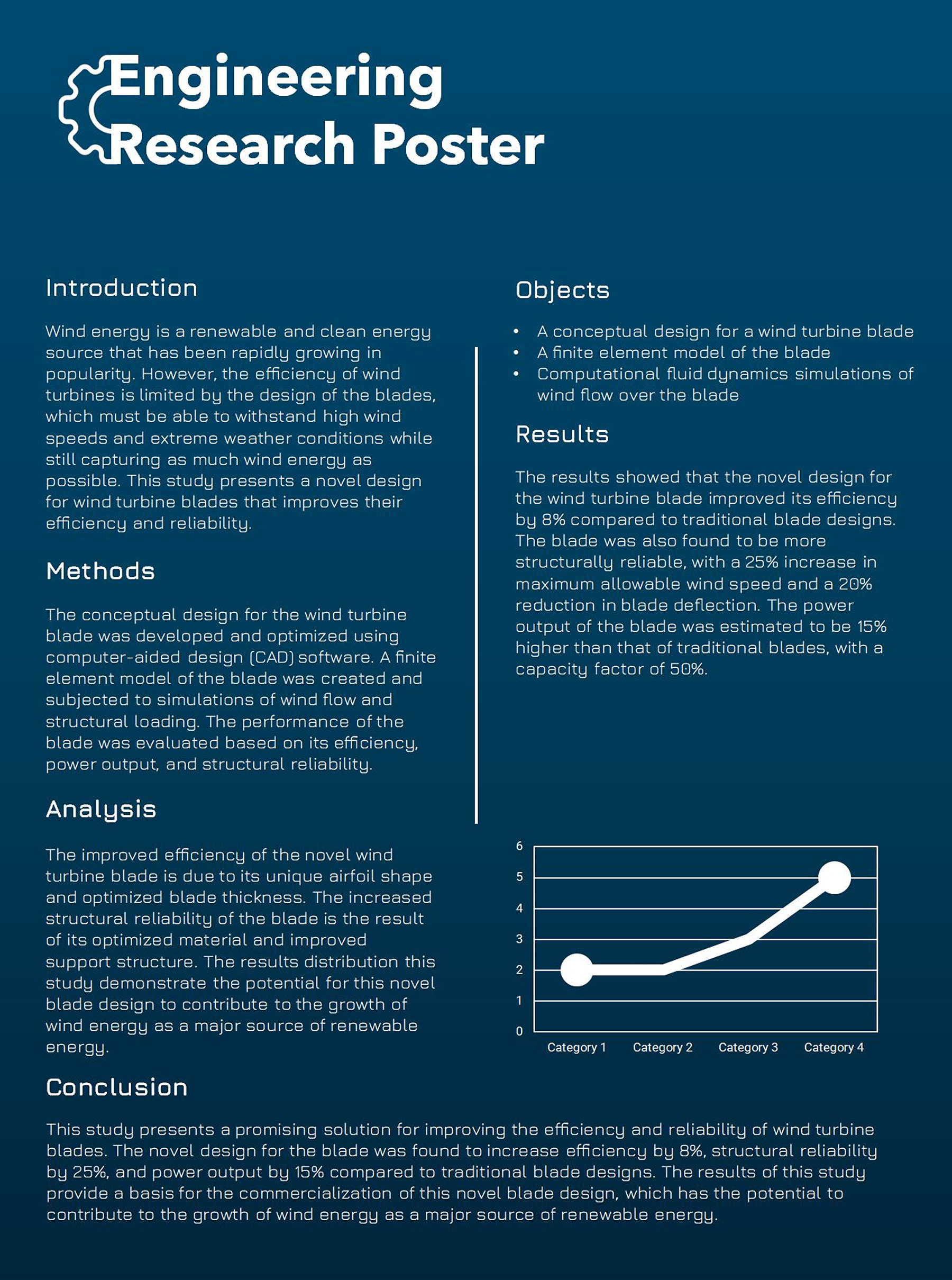
Engineering Research Poster Template
This is a clean, straight-to-the-point “blueprint” for breaking down an engineering or related project without making it boring. Like most of the engineering posters, this template doesn’t stack everything in one long flow; it splits the content into different sections that are super easy to read. They usually focus on process more than text.
At the top, you will write the title in BOLD words that sets the context quickly. Then you move to sections like Intro, Methods, Objects, Results, Analysis, and Conclusion one by one. Make sure they connect with each other. The templates also give you a graph where you can showcase your results in an appealing way.
3. Ecology & environmental poster
Ecology Research Poster Template
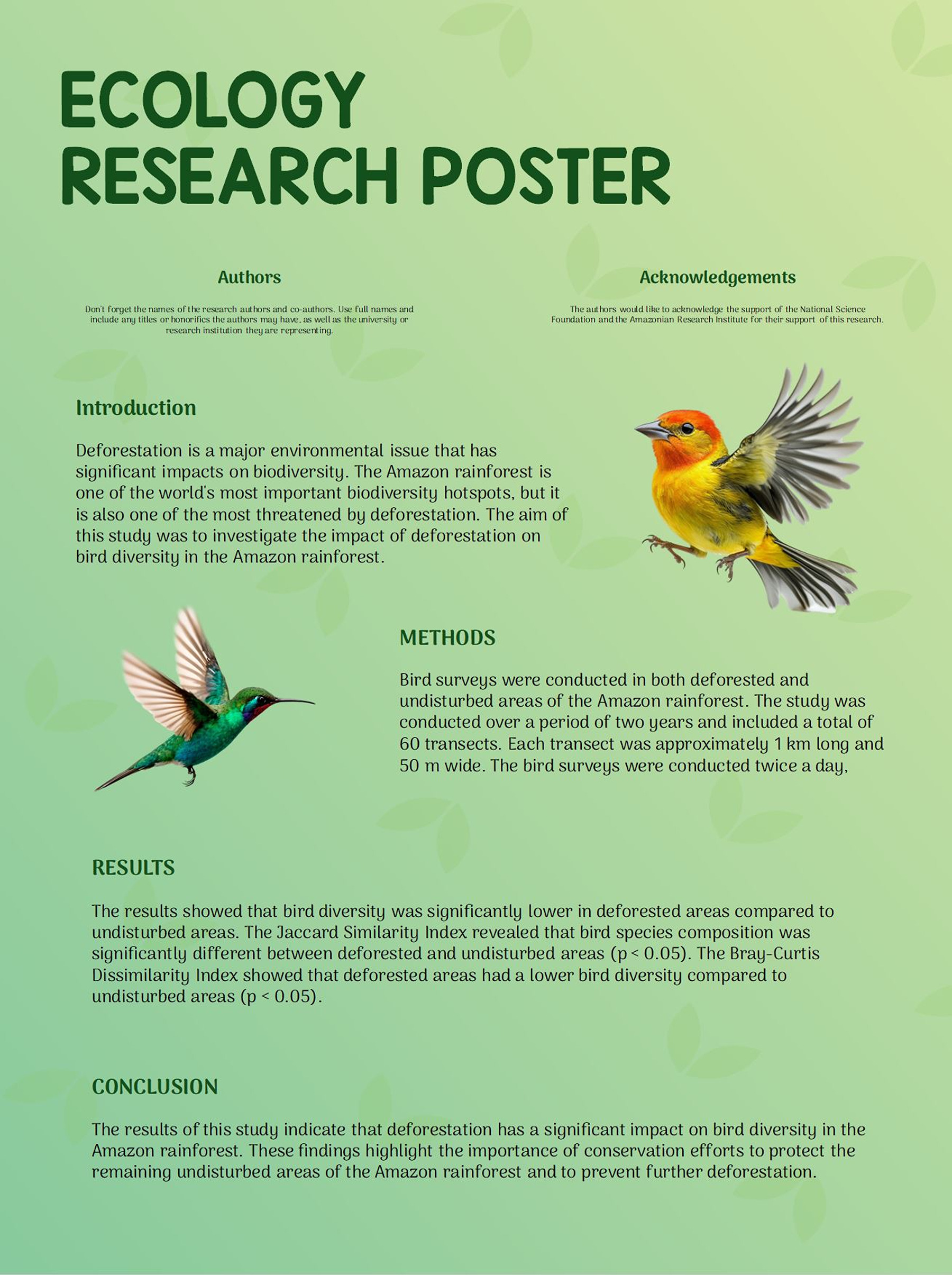
Ecology Research Poster Template
These posters rely heavily on visuals and a good color scheme that gives the eyes a refreshing look. The subtle design covers only 4 basic areas (intro, methods, results, conclusion) that avoid clutter and make the key points stand out. It is a perfect mix of “serious research” and “good design”, giving you complete freedom to talk about topics like deforestation and climate change, without boring the reader.
4. Creative research poster
Creative Research Poster Template
Creative Research Poster Template
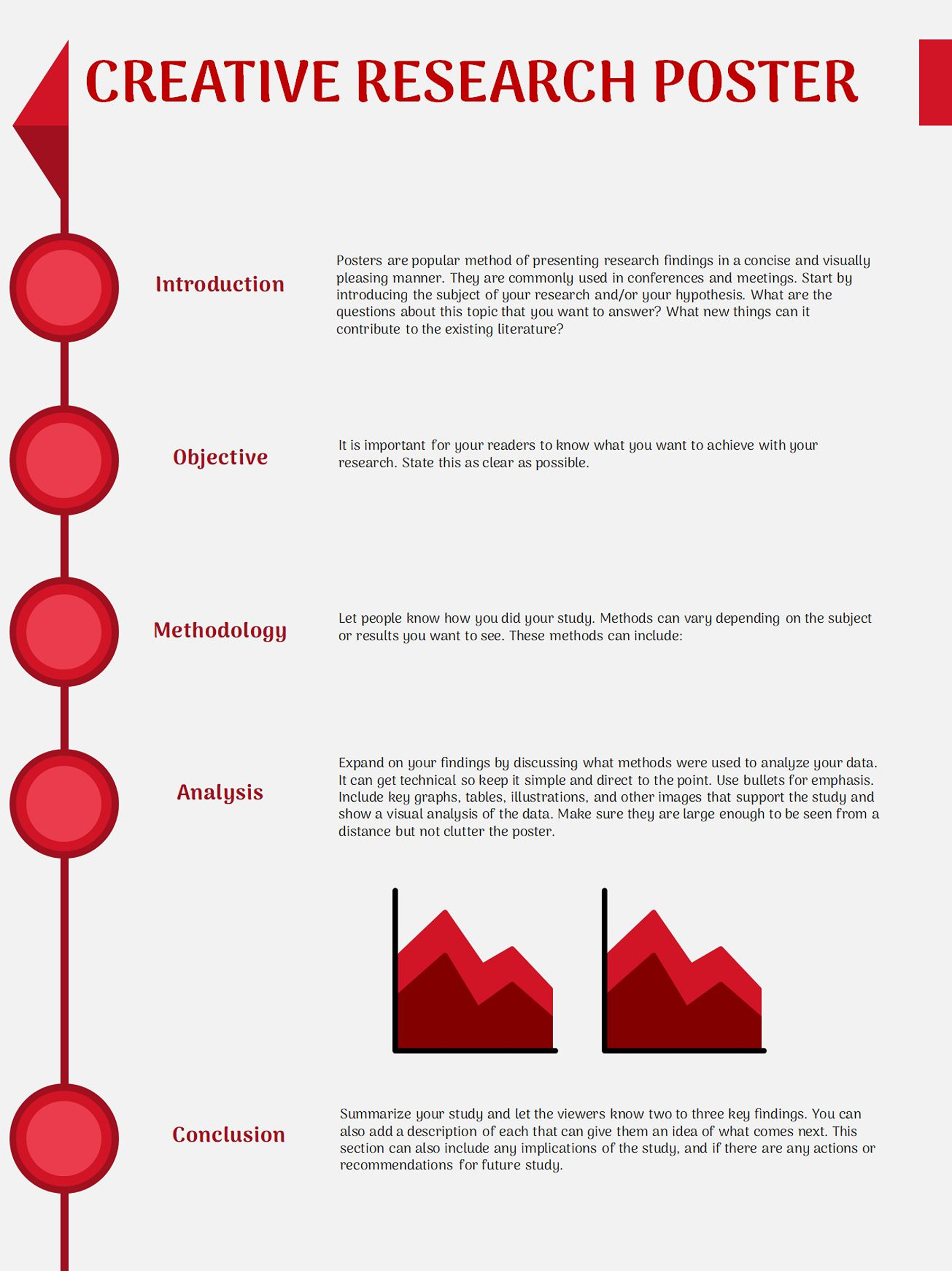
Forget the rigid, boxy grid research posters. This template is a total game-changer, spinning your research into a shiny, vertical timeline that’s as engaging as a visual story. After inserting the title right at the top, you need to come straight down to the introduction. No fluff, no extra things. From here, the template guides you through the objective, methodology, analysis, and conclusion. Moreover, it also has an option to address your findings (analysis) in a graph.
5. Computer science poster
Computer Science Research Poster Template
Computer Science Research Poster Template
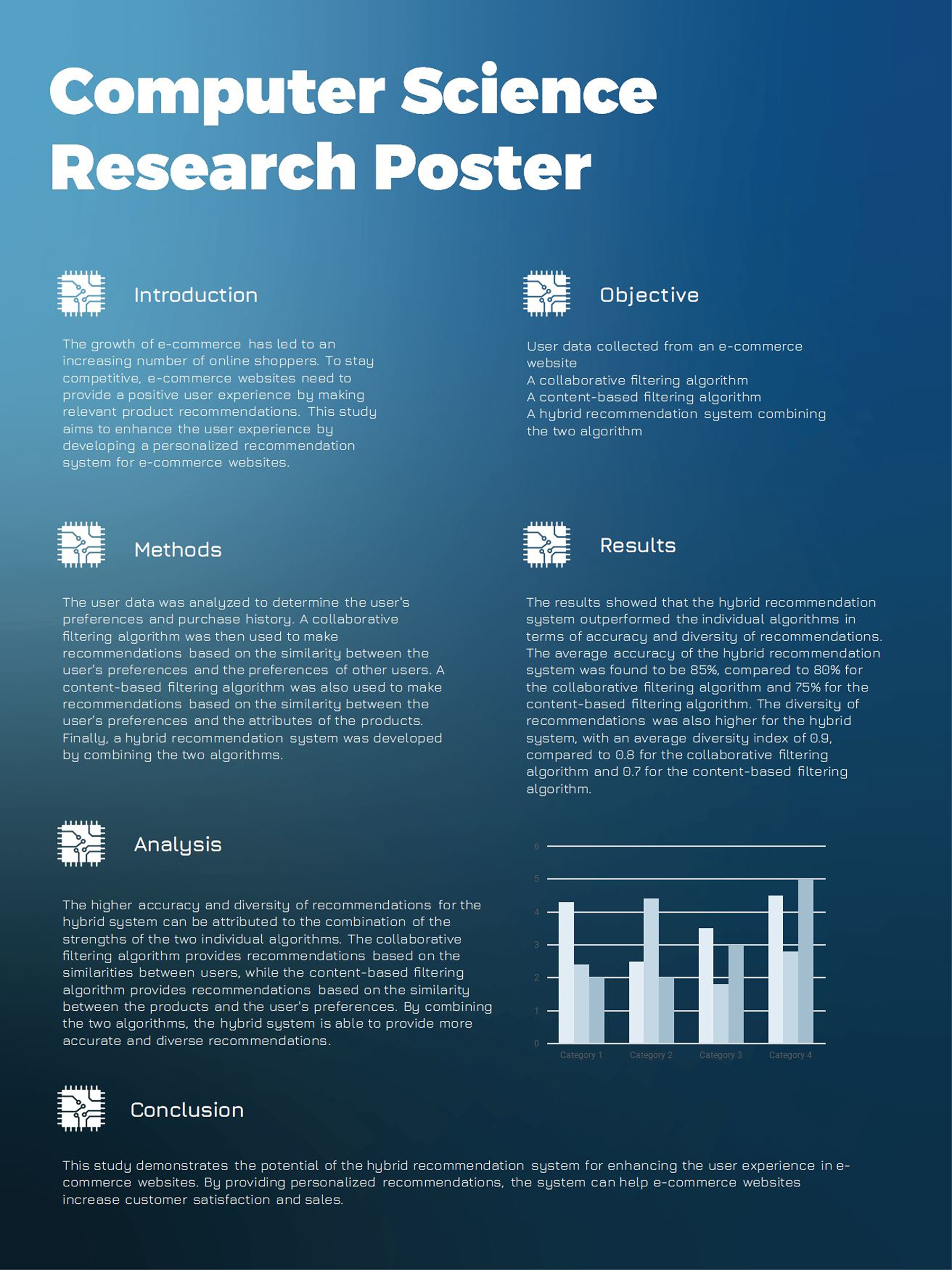
This is not just an ordinary poster; it’s a high-tech layout that is suitable for computer science or informational technology projects. By splitting the content into a two-column grid, the template gives you a clean format to explain your research perfectly. What we love about this poster template is its deep blue gradient that pulls people in, while the centered bar graph visualizes your entire project.
6. Chemistry research poster
Chemistry Research Poster Template
Chemistry Research Poster Template
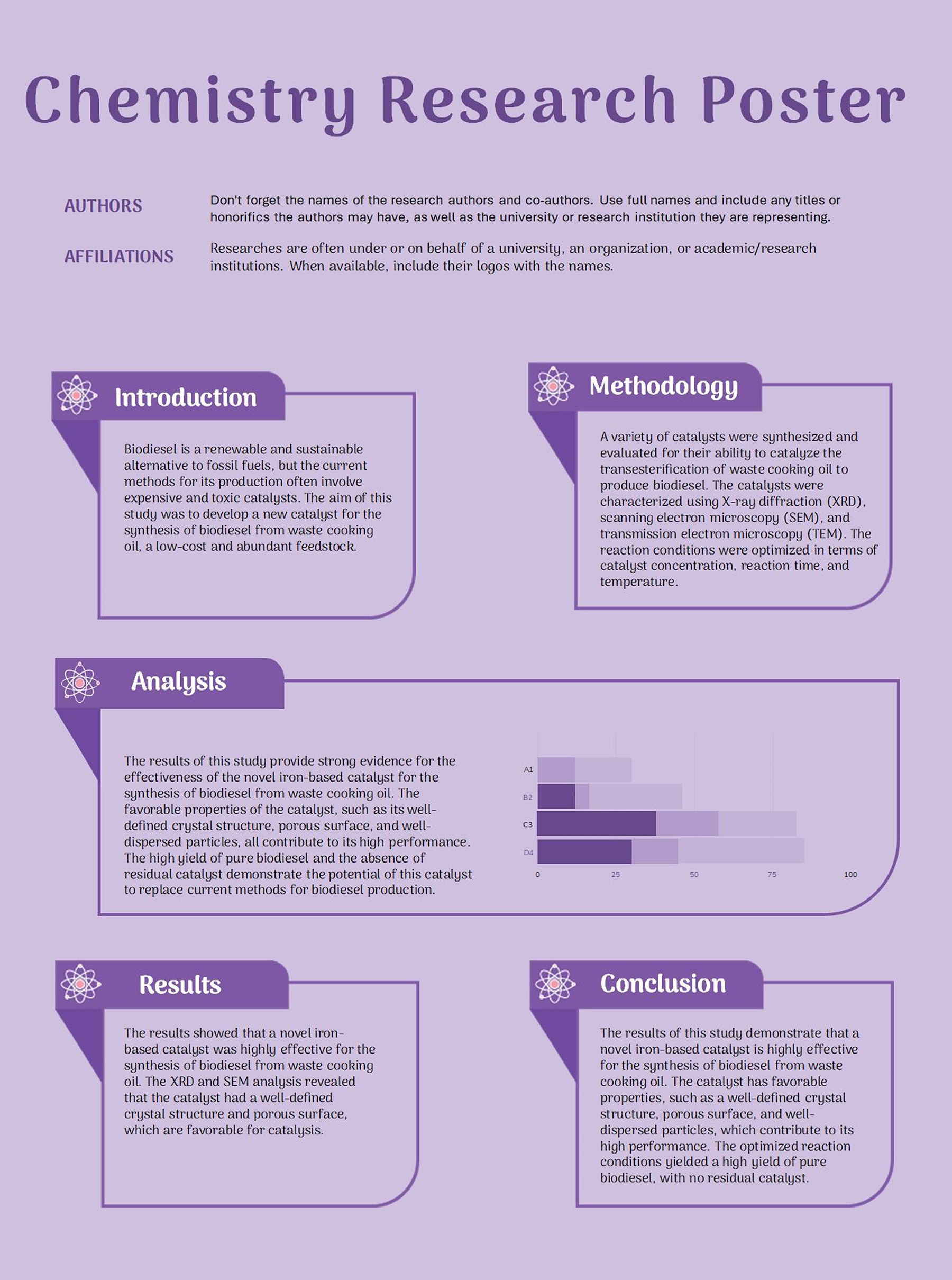
Chemistry research is most of the time dull, but this template actually makes your research poster interactive. It starts with a title and professional author credits before breaking the research into stylish, modular boxes that really bring the vibe. The overall layout is made for speed: you get a quick introduction and methodology at the top, a wide Analysis section in the middle, consisting of a sleek bar graph, and a final wrap-up with results and a conclusion at the bottom.
8. Biology research poster
Biology Research Poster Template
Biology Research Poster Template
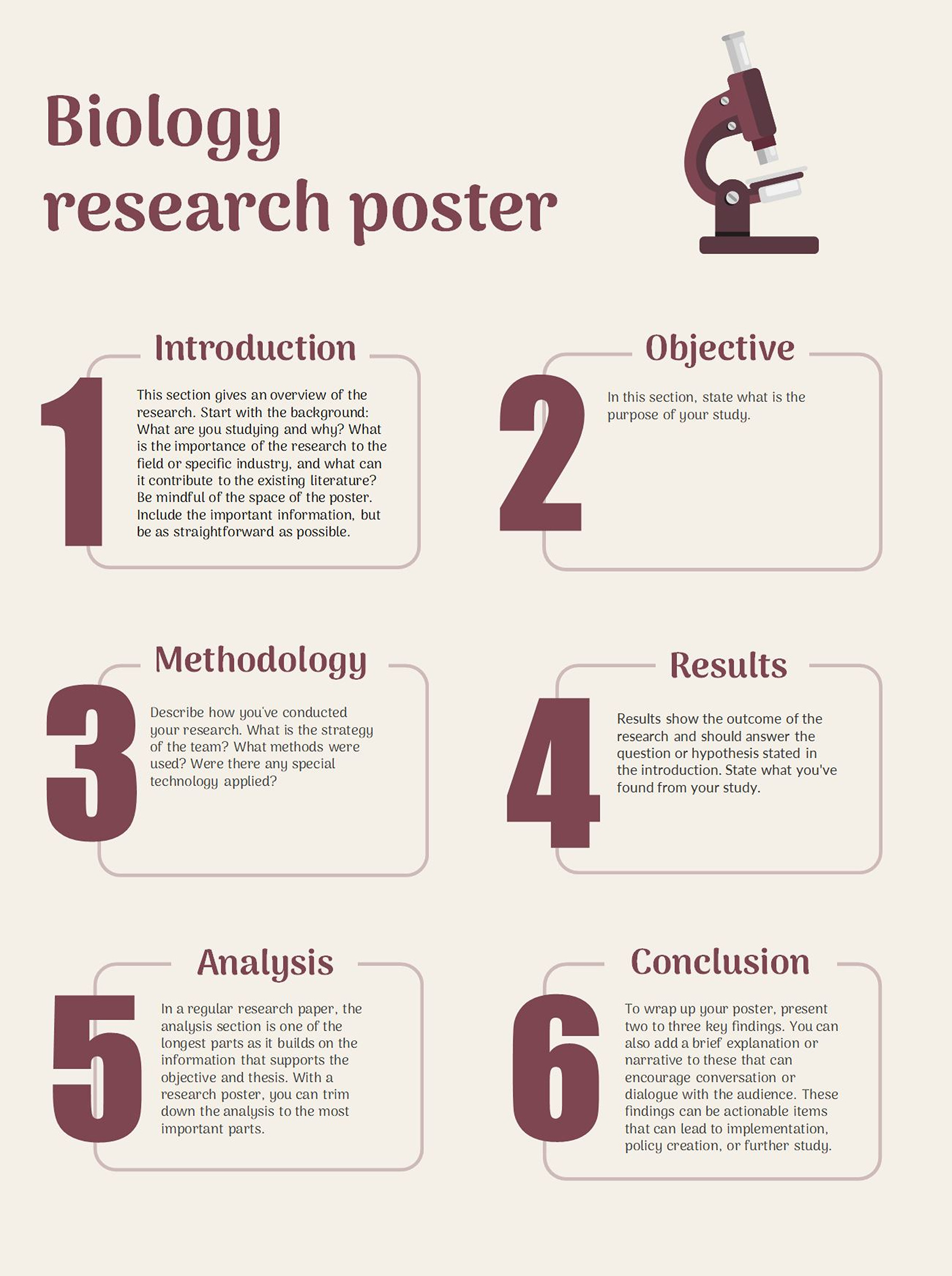
As you can see, this template is the true definition of a simple yet comprehensive poster. It focuses on detailed biological-related research and tries to fit in six sections, e.g., introduction, objectives, methodology, results, analysis, and conclusion. Just add significant information in the boxes and let this shine in your classroom or conference.
9. Anthropology & social sciences poster
Anthropology Research Poster Template
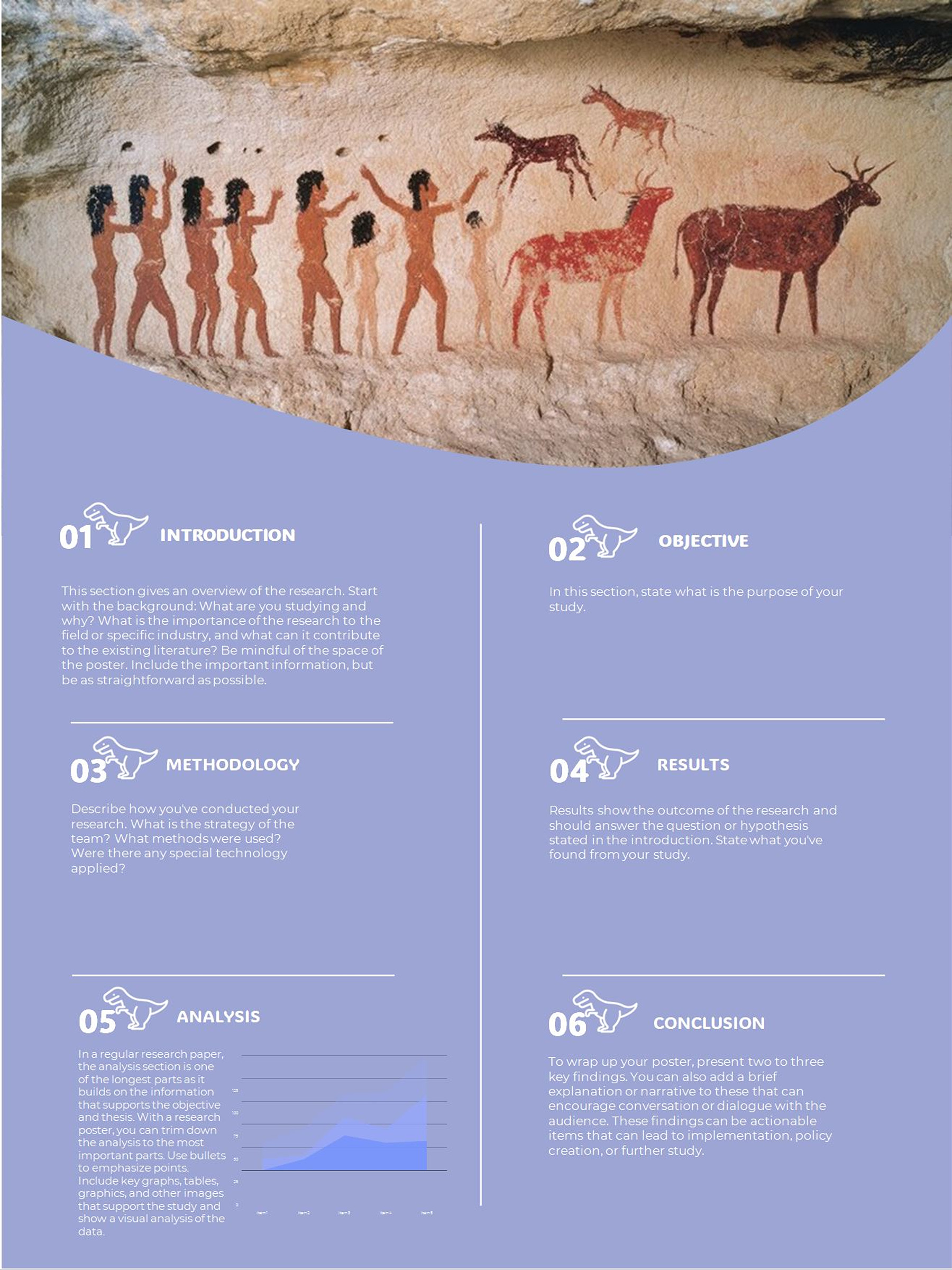
Anthropology Research Poster Template
The layout trades a boring title for a massive, immersive header image that instantly lets people know that it’s anthropological research. Usually, they are more narrative-based, and they combine storytelling with numbers so that the layout feels a bit more text-friendly. Talking about the template, it uses a two-column “split-screen” format that organizes the research into six numbered universal sections that connect to each other and make it impossible to lose track of.
10. Animal research poster
Animal Research Poster Template
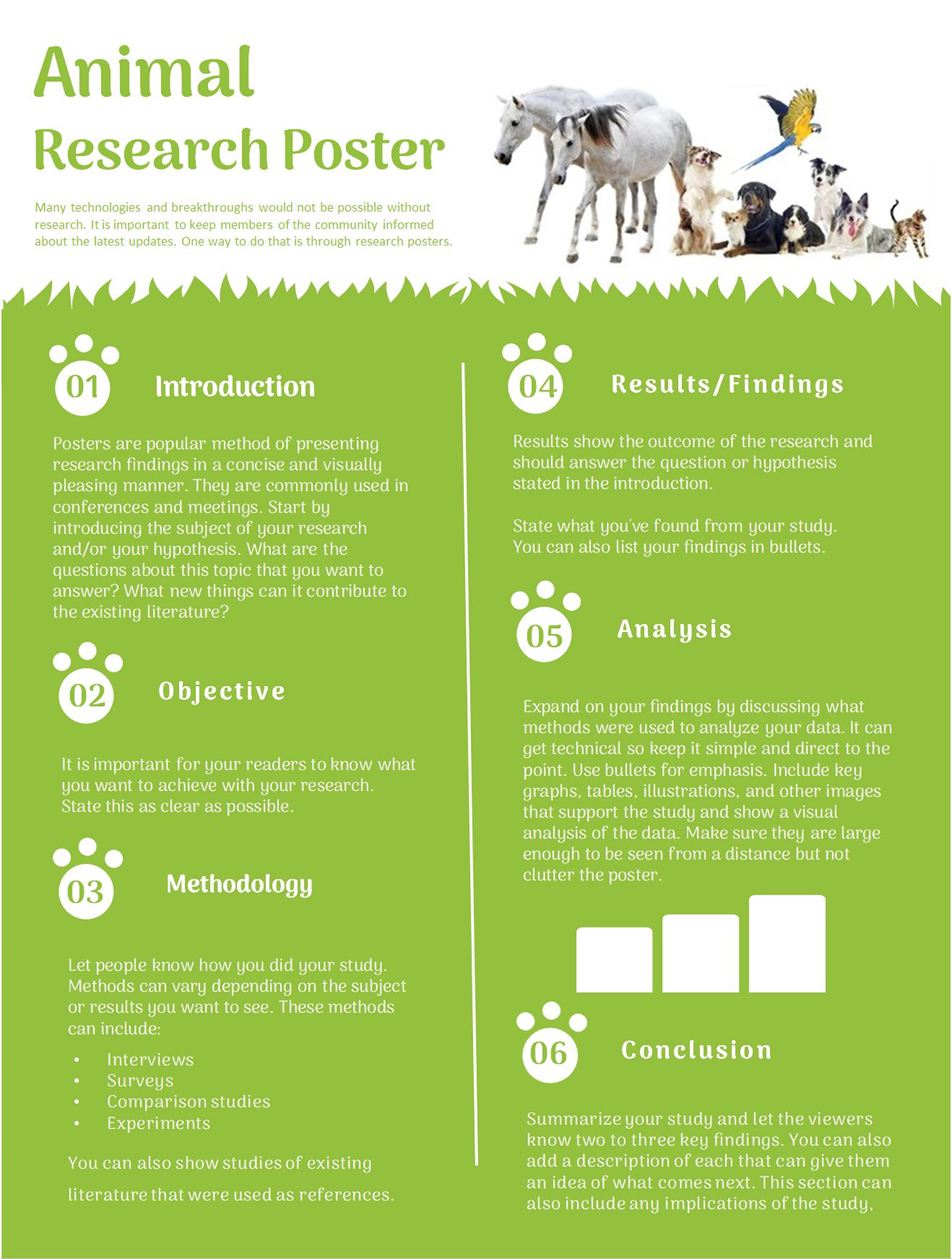
Animal Research Poster Template
The template focuses on the animal theme so that people can get a hint by seeing it. Observation is the key here, so it leans on visuals, patterns, and behavior summaries to help explain findings in a simple, engaging way. Like many other templates, this template is split down into major research sections to show the reader what this is about, what methods are used, what the findings are, and what it concludes.
11. General academic poster
Academic Research Poster Template
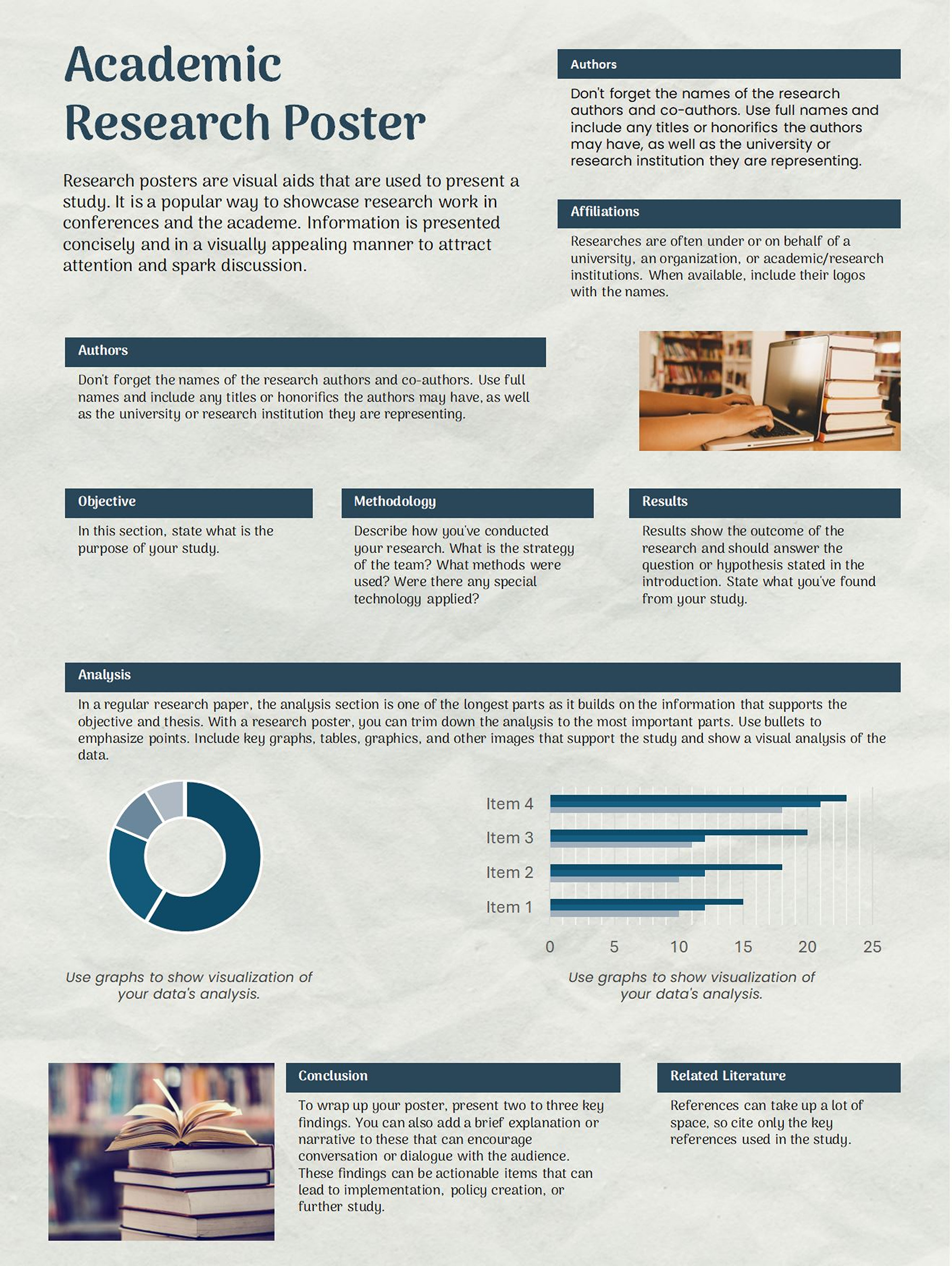
Academic Research Poster Template
The templates use a multi-column format that is perfect for comprehensive academic research. Well, it can also be used for all-purpose opt-ins. You can edit this template by writing the project title and contributor details in the header section. The middle section is all about how you did, what your objectives were, and what the findings were. Right below, you will visualize your data into charts and graphs to serve as the focal point. Then come down to the conclusion explanation, your “aha” moments.
If you want to add related research, you can use the related literature section. That’s all!
Why Do Some Posters Work While Others Don’t?
Well, most of the time, it’s subtle mistakes that completely underdo a solid poster. So, before you finalize your poster, do these quick fixes, and you’re good to go:
- Layout and Grid Structure (No clear flow): It means how well you put things in order. If you’re making people search for the main idea, they will lose interest. Keep the path simple so they can glide from one section to another without getting stuck.
- Typography and Font Selection: Being fancy here is not the right deal. Choose a font that is easy on the eyes. If someone has to squint or step closer to read, you must have done wrong.
- Color Usage: How and where you use colors is very important. Don’t go overboard; a few consistent colors are enough to highlight the important parts. Too many colors only make things messy and distracting.
- Visual Hierarchy: Not everything needs equal attention. Use your visuals in a way that stands out the key points and let the less important stuff sit in the background.
- Use of Graphics and Charts: Use these things when they actually help in explaining something. If a chart or table isn’t adding clarity, it is only taking up space.
- Forgetting Whose It Is for: This is a very common mistake. If you think using jargon will make you classy, you’re wrong. You will only lose your audience by drawing them into complex vocabulary. Keep it chill and use layman’s terms.
Wrapping Up
Most people have the wrong perception of a research poster, which leads them to make one that’s a complete disaster. It’s not about designing, it’s about editing and organizing content. If you think you will summarize your whole research, it will make good content for the poster; it will not.
You need a hierarchy of sections and a clear flow that holds your reader from start to end. That’s why a template is much needed. The best part? They offer a specialized layout for everything from medical research to ancient history and take care of structure, sections, and themes so that your main focus is on putting the details correctly.
Frequently Asked Questions
Well, there is no sure-shot answer. Design in a way that people can get the idea within the first few lines, and it is easily scannable. From our point of view, aim for 300-800 words.
You can, but subject-specific templates are a better option. Our templates come in different formats that match a specific field vibe, so that you can choose them.
Absolutely! Here, you need to use Google Slides and Microsoft PowerPoint versions to edit a template and make it according to your specific needs.
About This Article