A unit circle table shows the values of trigonometric functions at different angles. If you’re familiar with sine and cosine but less sure about tangent, secant, cosecant, and cotangent, seeing all six functions together can feel like a lot to work out. Fortunately, they all start with the same two coordinates.
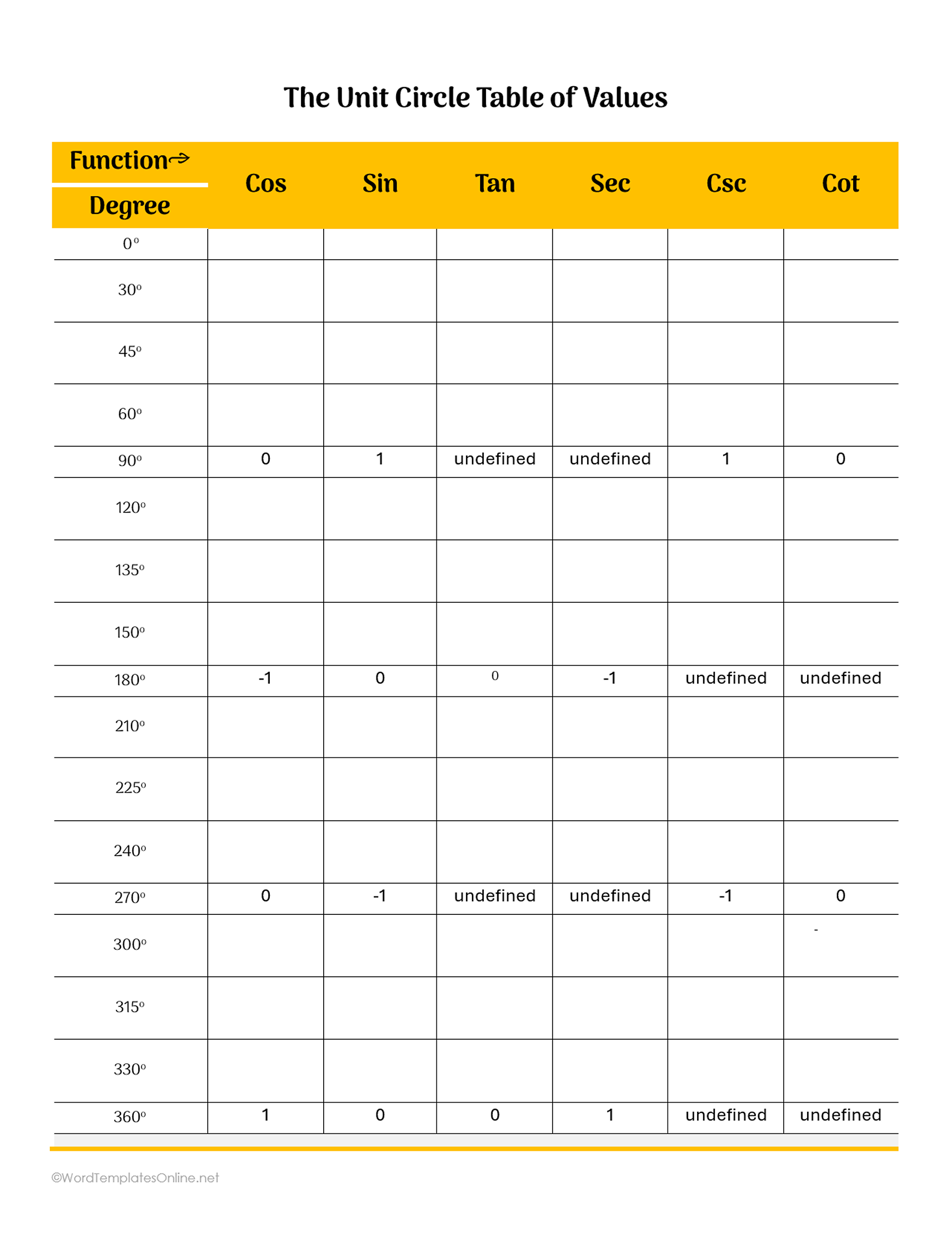
The editable unit circle table below lists 17 angles from 0° through 360°, with columns for Cos, Sin, Tan, Sec, Csc, and Cot. Four rows are already filled in: 90°, 180°, 270°, and 360°. The other 13 rows, including 0°, are left blank for practice.
This is a partly completed practice worksheet rather than a ready-filled reference chart or a circular diagram. You can use it to work through the values yourself or prepare an exercise for students. It’s available as a Microsoft Word template (DOTX), an OpenDocument (ODT) file, and a linked Google Docs template. You can fill in a working copy digitally or print the sheet and write your answers by hand.
Unit Circle Table Template
Unit Circle Table Template
Read all six functions from two coordinates
The unit circle is a circle with a radius of 1, centered at the origin (0, 0). When you choose an angle, a point on the circle tells you the values of cosine and sine for that angle.
Imagine drawing a line from the center of the circle at an angle of 30° from the positive horizontal axis. Where that line meets the circle, the point has two coordinates: (x, y).
The x-coordinate gives cosine, and the y-coordinate gives sine. If you’ve ever mixed up which one belongs to sine, remember that sine follows the vertical position.
The other four functions use those same coordinates. For an angle θ (theta), the relationships are:
- Cos θ = x and Sin θ = y.
- Tan θ = y/x and Sec θ = 1/x, provided x isn’t zero.
- Csc θ = 1/y and Cot θ = x/y, provided y isn’t zero.
Here, Tan means tangent, Sec means secant, Csc means cosecant, and Cot means cotangent.
The OpenStax explanation of the unit circle covers the connection between coordinates, sine, and cosine. Its guide to the other trigonometric functions explains the remaining relationships and when their values are undefined.
You don’t need to find six different points on the circle to complete one row. Find the two coordinates first, then use them to calculate the remaining values.
One rule is worth keeping in mind as you work: if a calculation requires division by zero, the function is undefined. That explains some of the entries already filled in on the worksheet.
Fill the 30° row from one pair of coordinates
Let’s use the 30° row in the downloadable table. It’s one of the blank rows, so you can follow the calculation and enter the answers into your own copy.
For 30°, the point on the unit circle has these coordinates:
(x, y) = (√3/2, 1/2)
These are standard special-angle values. They can also be derived from a 30°–60°–90° triangle. For this exercise, we’ll use the coordinates to work out the six functions.
The first two columns are straightforward. Cosine equals x, so Cos 30° = √3/2. Sine equals y, so Sin 30° = 1/2.
Now use those numbers for the other four columns.
Tangent divides y by x:
Tan 30° = (1/2) ÷ (√3/2) = 1/√3 = √3/3
Secant divides 1 by x:
Sec 30° = 1 ÷ (√3/2) = 2/√3 = 2√3/3
Cosecant divides 1 by y:
Csc 30° = 1 ÷ (1/2) = 2
Cotangent divides x by y:
Cot 30° = (√3/2) ÷ (1/2) = √3
With those calculations finished, here’s what you would write across the 30° row, following the same column order as the worksheet.
| Function | Value at 30° |
|---|---|
| Cos | √3/2 |
| Sin | 1/2 |
| Tan | √3/3 |
| Sec | 2√3/3 |
| Csc | 2 |
| Cot | √3 |
Notice that some answers contain square roots rather than ordinary decimals. These are exact values, and they’re commonly used when working with special angles.
You may also see tangent written as 1/√3 instead of √3/3. Both expressions have the same value. Similarly, 2/√3 and 2√3/3 are equivalent forms of secant. Follow the form your teacher or assignment requires.
There’s a quick way to check part of your work. Divide Sin 30° by Cos 30°. The result should agree with the tangent value you calculated earlier.
The six columns might have looked like six separate problems at first. They turn out to be different ways of working with the same pair of numbers.
The answers above are a worked example within this article. The downloadable worksheet itself remains partly completed, with its other blank rows available for practice.
Why zero and undefined are not the same
Some cells in the unit circle table contain 0, while others say “undefined.” These aren’t interchangeable answers.
Look at the completed 90° row. At this angle, the point on the unit circle is (0, 1). That means x is zero and y is one.
Cosine equals x, so:
Cos 90° = 0
Cotangent divides x by y:
Cot 90° = 0/1 = 0
Both calculations are valid. Dividing zero by a nonzero number gives zero.
Tangent is different. It divides y by x, which would give:
Tan 90° = 1/0 = undefined
Secant has the same problem:
Sec 90° = 1/0 = undefined
You can’t divide by zero. That’s why these cells say “undefined” rather than 0. It’s a mathematical distinction, not an unfinished calculation.
Cosecant is still defined at 90° because y is one. Its value is 1/1 = 1.
The reverse situation occurs at angles such as 180° and 360°, where the y-coordinate is zero. Cosecant and cotangent are undefined at those angles because their formulas would require division by zero.
When you’re filling the blank rows, check which coordinate appears in the denominator. If that coordinate is zero, the function is undefined. Writing 0 instead would give a different mathematical answer.
Let the quadrant signs help with the remaining blanks
Once you’ve worked through one special angle, you don’t have to treat every other angle as a completely new calculation. Many angles share the same reference angle, which is the smaller angle they make with the horizontal axis.
Consider 150°. It’s in the second quadrant of the unit circle, and its reference angle is 30°.
The coordinates at 150° have the same magnitudes as those at 30°, but their signs are different. In the second quadrant, x is negative and y is positive.
That tells you something before you calculate the functions. Cosine must be negative because it equals x. Sine must be positive because it equals y. Tangent must also be negative because it divides a positive number by a negative one.
You already know the coordinate values for 30°. You can use their magnitudes and the second-quadrant signs to work out the corresponding values at 150°.
The same idea applies to other angles on the worksheet. Their reference angles help you find the magnitudes, while the quadrant tells you which signs belong to the coordinates. From there, you can calculate the other functions.
One useful check: 0° and 360°
There’s another detail in the worksheet worth noticing. The 0° row is blank, but the 360° row is already filled in.
Both angles reach the same point on the unit circle: (1, 0). A complete turn brings you back to where you started.
That means the six trigonometric entries at 0° should match the corresponding entries at 360°. You can use the completed 360° row to check what you’ve entered for 0°.
Pay particular attention to cosecant and cotangent. Both are undefined because y is zero, even though cosine and secant have defined values.
The supplied table lists angles in degrees, which is why you’ll see labels such as 30°, 90°, and 180°. Radians are another way to measure angles, but this worksheet doesn’t include a separate radians column.
The table is also a manual exercise. It won’t calculate answers as you fill in the cells. You can work in your own editable copy or print it and write the values by hand. The original Word layout uses portrait US Letter pages, so check print preview after making changes.
For your next practice row, try 120°. Find its reference angle and decide which coordinate is positive and which is negative. Then calculate the six values using the same method you followed for 30°. Check the signs and denominators before moving on to another row.
About This Article