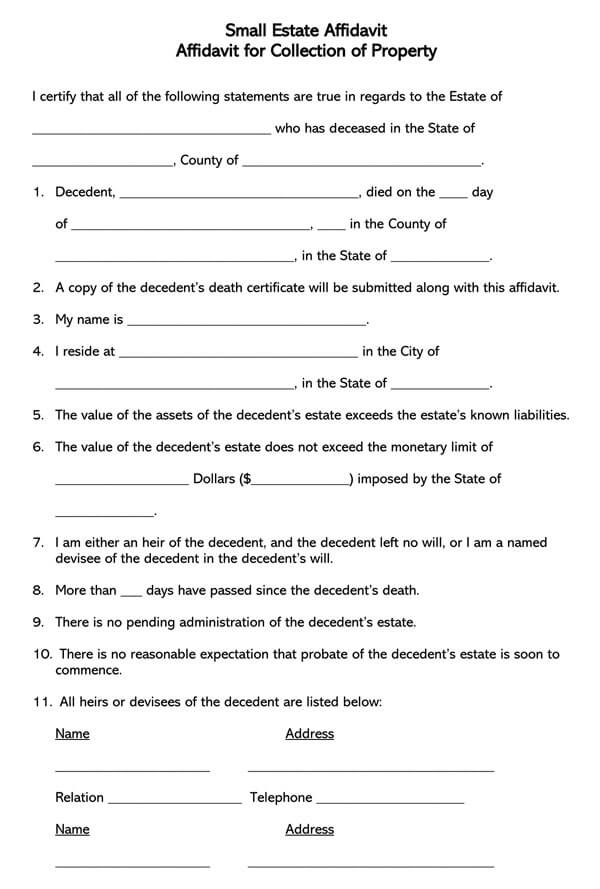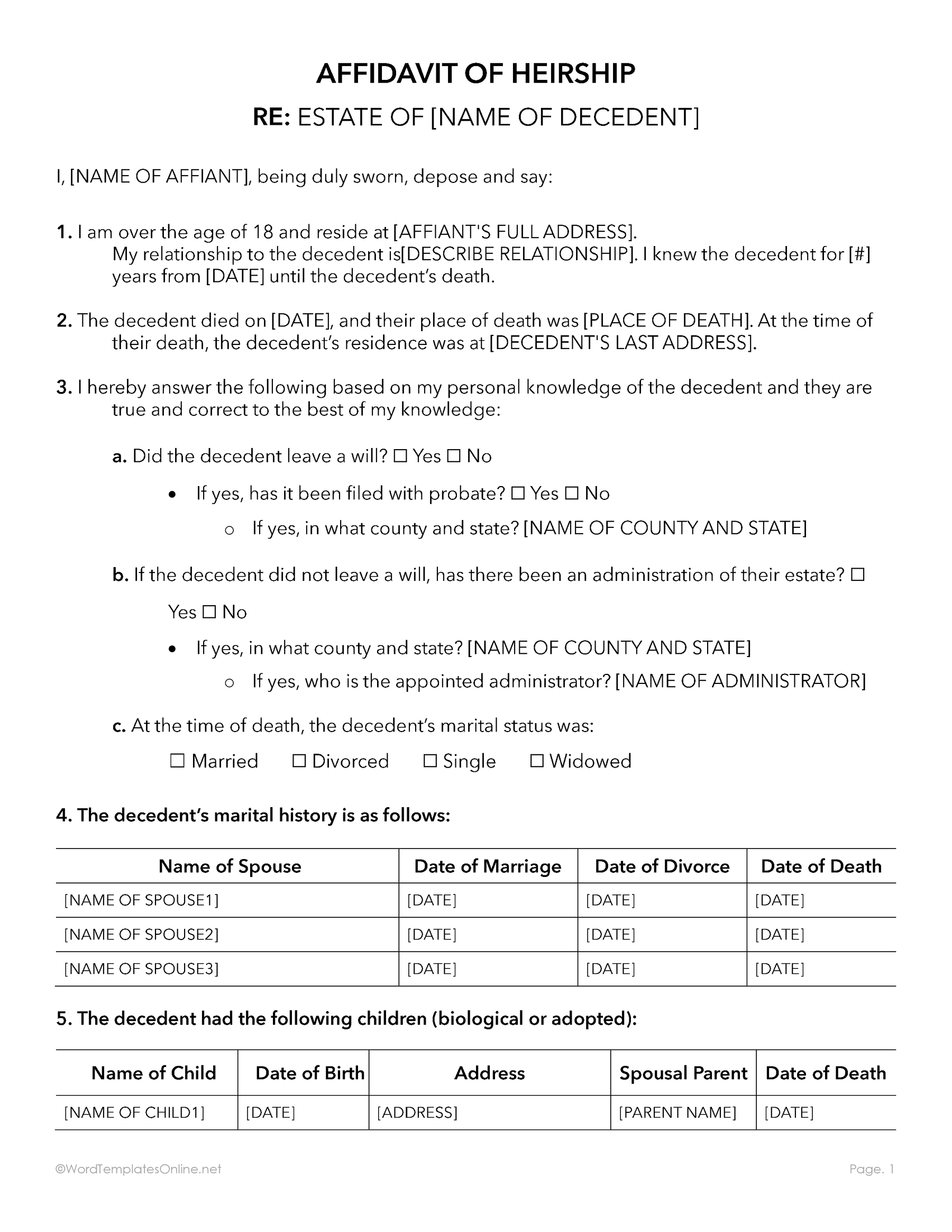
An affidavit of heirship is a legal document that is used to determine the heirs of deceased persons if they did not leave a will. It is often used when transferring assets to the heirs without going through a formal probate process (a process used to verify whether a will is valid). It also simplifies the process of transferring assets.
Purpose
An affidavit of heirship serves various purposes. It:
- Identifies the rightful heirs to a deceased person’s property by providing a legal record of the heirs
- Saves time and money by overlooking the probate process
- Allows heirs to claim ownership of a deceased person’s assets
- Acts as legal proof by serving as evidence of the heir’s inheritance rights
- Simplifies the transfer of assets to heirs, especially if there is no will.
- Provides a clear record of inheritance rights.
- Facilitates the transfer of other assets such as investments, bank accounts, etc.
- Avoids the probate process in identifying the rightful heirs in the absence of a will
- Provides a notarized account of the rightful heirs and their rights
Essential Information to Include
An affidavit of heirship has elements that make it legal when using it to identify heirs to a deceased person’s property. Below are the elements:
Affiant’s details
This is the first section of the affidavit. Here, you write the heir’s details, i.e., full name, address, age, and their relationship to the deceased. This verifies the heir’s credibility connection with the deceased.
EXAMPLE
I, Jim Travis, age 25, residing at 123 Kingston St, Queens, NY, am the Nephew to the deceased.
Decedent’s information
In this section, write the deceased’s information, i.e., their full name, last known address, date of death, and last known address. This identifies the deceased person and verifies that they have passed.
EXAMPLE
Kris Dan, who resided at 123 Kingston St, Queens, NY, passed away on February 27, 2025, at Brooklyn General Hospital.
Will and probate status
In this section, state whether a will (if any) written by a deceased has been submitted to probate. It confirms whether the property is going through legal channels or whether an affidavit is required for the transfer of property to heirs.
EXAMPLE
To the best of my knowledge, Kris Dan did not leave a will, and no probate proceedings have begun in any court.
Marital history
Here, write the spouse’s details i.e. their name, any marriages, divorce or death. This is important in determining whether the spouse is entitled to a share of the deceased’s property.
EXAMPLE
Kris Dan was married to Martha Dan on August 7, 2006, and she passed away on October 18, 2022. He did not remarry.
Children and descendants
This section requires details of the children and descendants of the deceased. Write their names, addresses, birth dates, if any child is deceased, and any grandchildren. This is important since the law prioritizes the children’s descendants first.
EXAMPLE
Kris Dan had two children: Chris Dan, born March 4, 2004, residing at 764 Lincoln Ave, and Jackson Dan, born July 23, 2001, residing at 248 Port St.
Parents and siblings
If there are no children or descendants, identify the deceased’s parents and siblings. This helps determine the next closest relatives who will inherit the property.
EXAMPLE
Kris Dan’s parents, Sam and Teresa Dan, are both deceased. He remains with one sibling: Esther Dan, age 30, residing at 195 State Rd.
Extended family
If there are no parents and siblings either, identify any extended family members such as nieces, nephews, aunts, etc. It recognizes distant relatives in case there are no close relatives left.
EXAMPLE
Kris Dan had no surviving parents, siblings, or children. His nearest living relative is his nephew, Jim Travis, residing at 665 Kings St.
Real estate and assets
This is where you give a legal description of the assets that belonged to the deceased.
EXAMPLE
At the time of his death, Kris Dan owned 3 parcels of land located at 33 Berry St, Maryland, as well as a vehicle—a 2017 Land Cruiser Toyota Prado.
Outstanding debts
List any unpaid debts the deceased owed. This ensures that the debt issue is addressed before the transfer of assets.
EXAMPLE
Kris Dan had an outstanding mortgage of KES 1,100,000 on his Maryland property.
Declaration
In this section, the heir verifies that the information given is accurate and true to the best of their knowledge.
EXAMPLE
I, Kris Dan, solemnly swear that the information contained in this Affidavit of Heirship is true, correct, and complete to the best of my knowledge and belief.
Signature and date
Here, the affiant is required to sign and date the affidavit. This is done in the presence of a notary public for authenticity.
EXAMPLE
Signature: _______________________________
Name: Kris Dan
Date: March 25, 2025
Notary section
This is the last section of the affidavit. It is an acknowledgment by a notary public that the affiant’s identity is valid and that the affidavit was signed voluntarily.
EXAMPLE
Notary Public Signature: __________________________
Notary seal:
Commission Expiry Date: __________________________
Free Templates
A free, editable, and ready-to-use affidavits of heirship template is available on our platform that you can access. The templates will assist you in writing an affidavit that facilitates a smooth transfer of property or assets to the rightful heirs.
Affidavit of Heirship Form
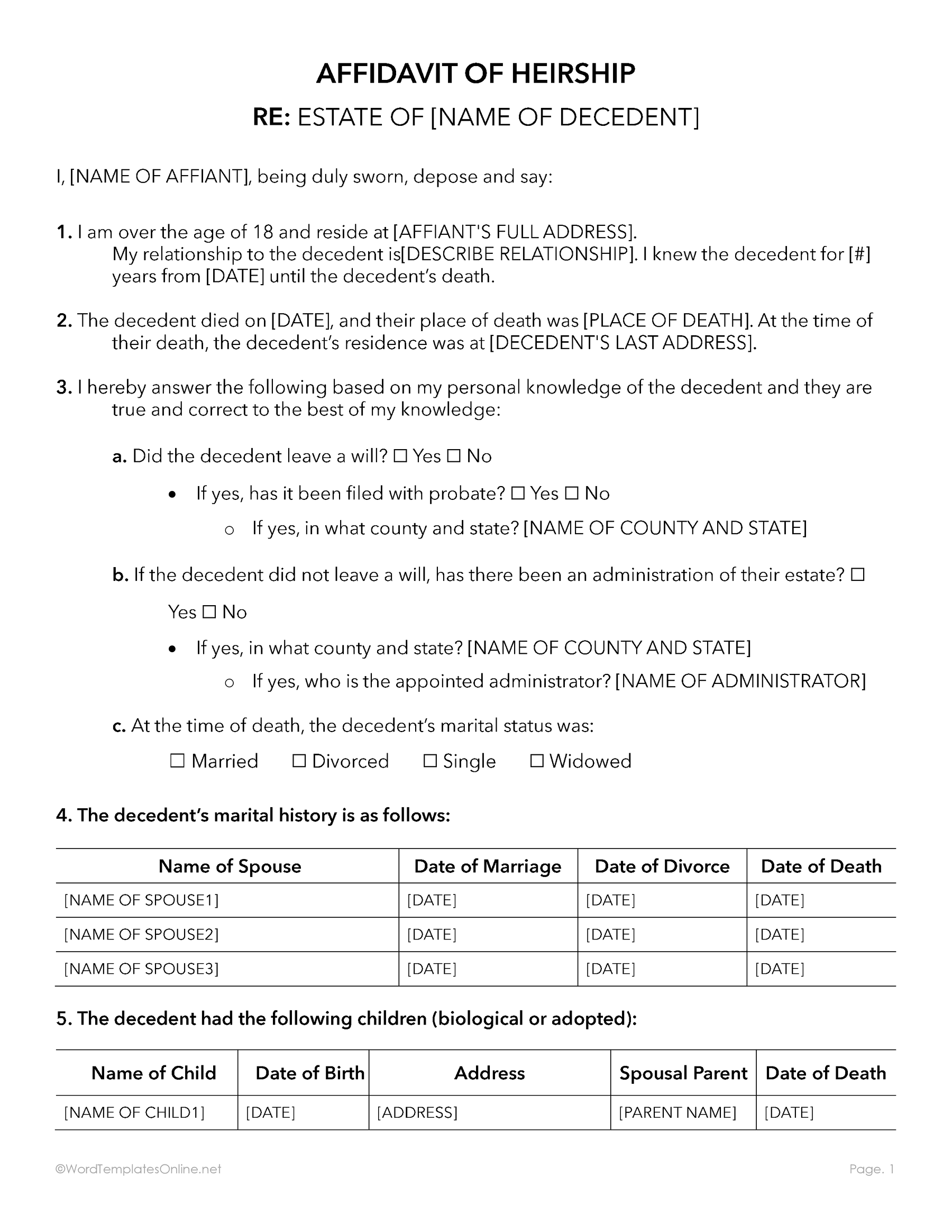


Affidavit of Heirship Form
Related:
- How to Write an Affidavit | 17 Types – Free Templates
- Free Self-Proving Affidavit Form | Attach to Will or Codicil
Conclusion
An affidavit of heirship is an important document to have, especially when a person dies without writing a will. It helps heirs avoid the long probate process while making sure that the deceased person’s estate is distributed equally among heirs. Also, an affidavit of heirship template simplifies the verification process by ensuring that all the important information, such as family details, property descriptions, etc.
About This Article