No doubt, buying a home is a major financial milestone. But for some people, saving enough for a down payment or closing cost is the hardest part of the process. In such cases, financial support from a close person can make this process easier. However, when someone gives you money for a down payment, lenders need proof that the funds are truly a gift, not a loan. As loaned money can affect your ability to repay the mortgage.
This is where gift letters for mortgages become important.
If you are a donor or a gift-giver, recipient, or mortgage professional, this blog will address your confusion. It provides a complete, easy-to-understand guide based on leading industry standards. This will also help you understand the purpose and structure of a gift letter, which can save you time and avoid delays in loan approval.
What Is a Gift Letter for Mortgage?
A gift letter for a mortgage is a formal, written declaration. Its basic purpose is to specify that a specific amount of money given to a homebuyer is a non-repayable gift. It assures lenders of the following:
- Down payment money is not a loan.
- Homebuyers don’t need to pay back the money they received as a gift.
- Gifted money has no hidden conditions, agreements, or expectations.
- It comes from a legitimate, verifiable source.
In short, it protects lender by assuring that the borrower is not secretly taking on extra debt that could affect mortgage repayment.
Why Do Mortgage Lenders Require a Gift Letter?
United States mortgage lenders follow strict guidelines to assess a borrower’s financial stability. When a buyer receives money for a down payment, before accepting it, lenders must verify that:
- The money is not a loan, and a gift letter clarifies that the funds are freely given.
- Lenders are required by federal law to verify a borrower’s ability to repay a mortgage. Under the Dodd‑Frank Wall Street Reform and Consumer Protection Act, the Ability-to-Repay (ATR) / Qualified Mortgage (QM) rule mandates that lenders make a reasonable and good-faith determination of a borrower’s ability to repay the loan.
This includes reviewing borrowers’ all sources of funds. This is why lenders often require a gift letter to confirm that any gifted money used for the down payment is legitimate and does not create repayment obligations. Because if gifted funds are actually a hidden loan, they can result in a violation of ATR/QM standards. - The donor/giver and gift must meet program-specific requirements. For example, under the Federal Housing Administration (FHA), gift funds must be “no-strings-attached,” they should be genuine gifts and not hidden loans or disguised debts. The gift letter must state that no repayment is required.
- Funds must be traceable. For loans insured or guaranteed by FHA, lenders must see actual bank documentation. It includes evidence that funds were debited from the donor or gift-giver’s account and deposited into the borrower’s account. Acceptable proof includes a canceled check and deposit slip, a withdrawal slip and deposit slip, or electronic transfer records.
All these requirements help lenders maintain transparency and comply with federal lending laws. It also protects both borrower and lender from hidden debt or fraud.
When Do You Need a Gift Letter?
A gift letter is required when gifted funds are being used for:
- Down payment: Initial amount of money the buyer pays upfront when buying a house.
- Closing costs: Amount the buyer pays at the final stage of buying a house.
- Reserves: Extra savings that prove the buyer can still afford your mortgage payments even after paying the down payment and closing costs.
For example, if your lender demands 3 months of reserves and your total monthly mortgage payment is $2,000. It means that your account must show $6,000 balance remaining after closing.
Properly documented gift letters and fund transfer proof are often required under the ATR/QM rule. Without documentation, lenders may treat the funds as potential undisclosed debt, which can delay loan approval.
Loan type limits
When using gifted money for a home purchase, it’s important to understand that loan types set limits on how much gift money you can use.
Conventional loans allow gifted funds to cover the down payment, closing costs, and reserves. For instance, if you’re getting a conventional mortgage for a primary home, you can use gift funds for up to 12% of a 15% down payment or 22% of a 25%. But if you wanna buy a second home, limits may differ.
Federal Housing Authority (FHA) loans let you use gift money for down payment and closing costs only for primary homes.
While Veterans Administration (VA) and United States Department of Agriculture (USDA) loans are typically for primary homes, they allow gifts only for closing costs (as down payments aren’t required).
Who Can Provide a Mortgage Gift?
Who can provide a mortgage gift depends on the lenders, their policies, and the type of mortgage. Each has its own rules about who’s allowed to contribute.
- For conventional loans, lenders usually accept gifted funds from family members (parents, siblings, children) or someone with a romantic relationship, such as a fiancé or spouse.
- As compared to conventional loans, FHA loans are more flexible. Their guidelines allow gifts from various personal and professional relationships on one condition: that is, no repayment. Funds can come from family, friends, employers, labor unions, and charitable organizations.
- For VA loans, lenders accept gifted funds from anyone as long as the giver isn’t involved in the sale of the home.
- Just like VA loans, USDA loans also allow gifted funds from anyone who is not benefiting from the sale or purchase of the property.
Gift Sources Lenders don’t Accept:
Lenders don’t allow gifts from:
- Real estate agents
- Investors
- Builders
- Developers
- Anyone financially benefiting from the sale.
This is why gift mortgage letters include clear declarations that the giver is not going to get any benefit from the property purchase.
What Should a Good Gift Letter for Mortgage Include?
A strong gift letter must include these key elements:
1. Gift-giver/donor’s full name and contact details
A gift letter should include the donor/gift-giver’s full name and complete contact information. The lenders may require them in order to identify the giver.
2. Recipient’s name and relationship to donor/giver:
The letter must also clearly mention the recipient’s name and their relationship to the person providing the funds. The recipient has to make sure that their relationship with the giver/donor is genuine and allowed under the lender’s polices.
3. Gift amount
Be sure to state the exact amount that the recipient is receiving as a gift. It will allow the lender to understand the contribution and also keep it transparent for both the giver and the receiver.
4. Purpose of the gift
Write the purpose of the gift, such as a down payment, closing costs, or both.
5. Property address
Be sure to include the property’s address where the gifted money will be used. This ties the gift directly to a specific purchase and makes it clear to the lender that the funds are intended for that home.
6. Source of funds
It is necessary to mention the donor/gift-giver’s bank name, account number, or institution. This shows lender that the funds are legitimate and traceable.
7. Declaring money as a gift
This is the backbone of the entire receipt acknowledgement. It clearly says that the funds will not be returned. This statement keeps both parties safe from any confusion.
8. Declaration of no conflict of interest
It is standard to add a declaration of no conflict of interest for regulatory compliance. It reassures the lender that the person giving funds is not connected to the property in any way and that the gift is for support only.
9. Gift-giver and recipient signatures
Lastly, both the gift-giver/donor and the gift-taker need to sign the letter as proof of authenticity. Having both signatures confirms agreement and accountability.
All of this information provided ensures that the letter meets the lender’s requirements. It also reduces their chances of delay.
Gift Letter Templates
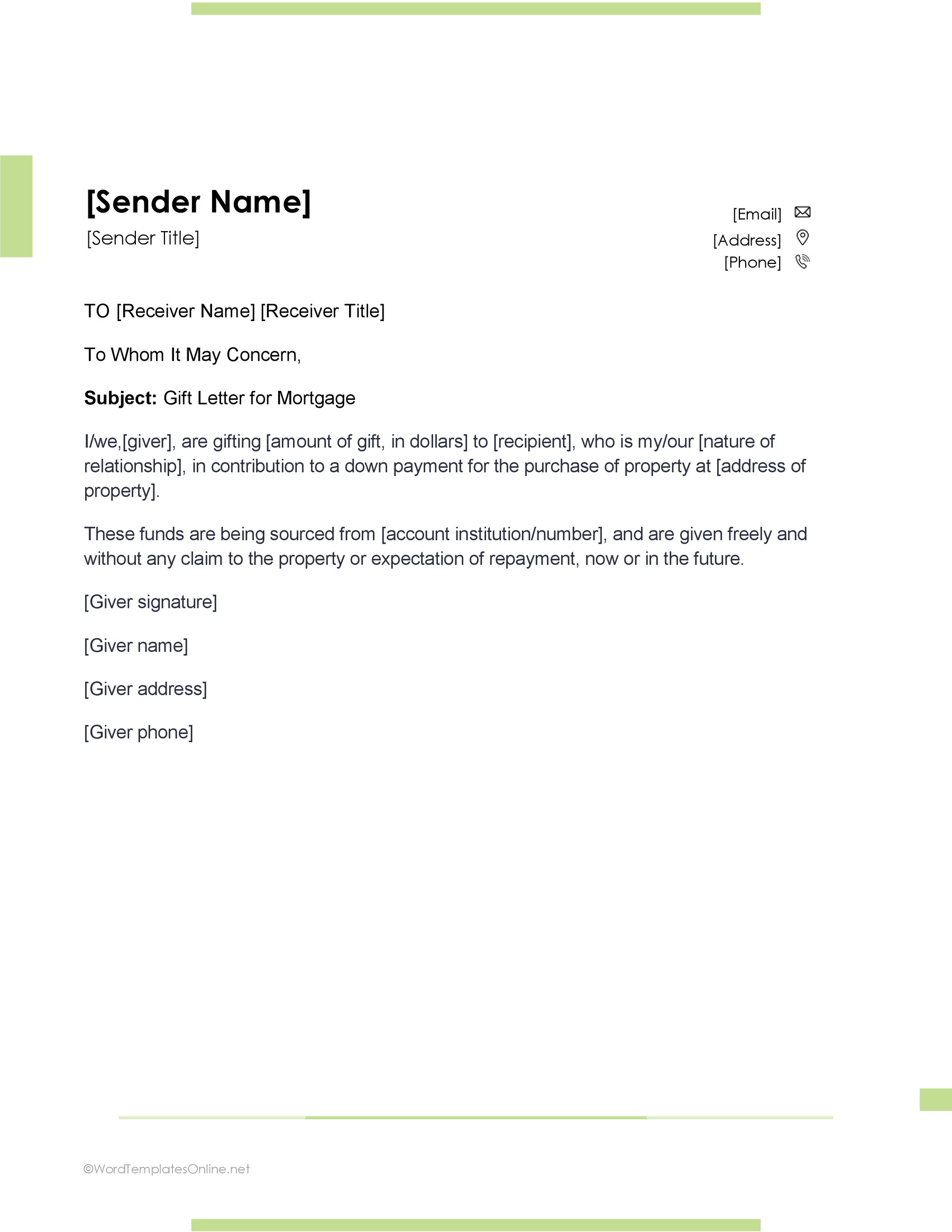
Template 1
[Sender Name] [Email]
[Sender Title] [Address]
[Phone]
TO [Receiver Name] [Receiver Title]
To Whom It May Concern,
Subject: Gift Letter for Mortgage
I/we,[giver], are gifting [amount of gift, in dollars] to [recipient], who is my/our [nature of relationship], in contribution to a down payment for the purchase of property at [address of property].
These funds are being sourced from [account institution/number], and are given freely and without any claim to the property or expectation of repayment, now or in the future.
[Giver signature]
[Giver name]
[Giver address]
[Giver phone]
Gift Letter for Mortgage Template 01
template 2
[Sender Name] [Email]
[Sender Title] [Address]
[Phone]
TO [Receiver Name] [Receiver Title]
To Whom It May Concern,
Subject: Gift Letter for Mortgage
To Whom It May Concern:
I, [DONOR’S NAME], being duly sworn, hereby swear and affirm:
- I have given a gift in the amount of $[GIFT AMOUNT] to [RECIPIENT’S NAME] on [DATE OF TRANSFER].
- The recipient is [RELATIONSHIP OF DONOR TO RECIPIENT].
- This gift is to be applied toward the down payment or closing costs on the property located at [PROPERTY ADDRESS].
- The source of gift funds is [ACCOUNT NAME, ACCOUNT NUMBER, INSTITUTION NAME].
- This is an outright gift free of any obligation, express or implied, or expectation of repayment in the form of cash or services of any kind now or in the future.
- No conflicts of interest, side dealings, or other agreements exist between any party in the sale of the property, direct or indirect, with respect to this gift.
- I am not, nor do I have any association with, the builder, developer, real estate agent, or any other interested party to the transaction.
The undersigned certifies that the facts set forth in this statement are true and accurate.
Sincerely,
[Donor]
[Recipient]
Gift Letter for Mortgage Template 02

How to Get Your Gift Letter Accepted by Lenders
If you want to get your gift letter accepted to avoid delays in loan approval, follow these best practices:
- Provide the gift-giver’s bank statements to verify whether funds are available.
- Document the money transfer clearly. It’s highly recommended to use traceable methods like bank transfer, cashier’s cheque, or wire transfer.
- Avoid handing over large cash amounts, as they are harder to track and may raise concerns.
- Keep all copies of the record, including proof of transfer, gift letter, and confirmations, as the lender may demand them.
- Make sure the amount in the bank record matches the amount in the gift letter. Double-check that all numbers are accurate to prevent additional questions from the lender.
Common Mistakes to Avoid
Here are a few pitfalls that you should avoid to get your gift letter for mortgage accepted.
- Don’t take cash without proper documentation. Always use traceable methods so the lender can verify the funds.
- Changing the gift amount after transfer can disrupt the whole process. Any change, even of a few hundred dollars, can confuse the lender and may require explanations.
- The donor/giver should have no connection to the property sale to avoid conflicts of interest.
- Make sure the relationship listed matches what the lender allows, like parent, sibling, or spouse.
- Missing signatures
- Avoid unclear or vague statements. Clearly state that the gift does not need to be repaid in any form.
Frequently Asked Questions
Can a gift letter be backdated or used for past payments?
No! Lenders require that gift letters reflect the actual date the funds were given or transferred. Using backdated letters or applying a gift to payments already made can be considered fraudulent and may jeopardize loan approval.
What happens if the actual gifted amount differs from what was listed in the gift letter?
If the gifted amount changes (for example, the gift-giver originally promised $20,000 but only transferred $14,000), you typically need to update the gift letter and supporting documentation to match the actual amount transferred. Lenders usually review both the letter and the wire/transfer documents during underwriting. In some cases, you can submit multiple gift letters if additional funds are added later.
Can I repay the gifted funds without affecting the mortgage?
No, you can’t repay the gifted funds without affecting the mortgage. The critical point is that during the mortgage process, lenders must see that the funds were a true gift with no expectation of repayment. Any signs of repayment before closing could reclassify it as a loan and jeopardize approval. However, once the loan has closed and the gift letter terms have been correctly followed, you can repay the donor/giver as a personal decision. It won’t affect the mortgage, but it should not be part of the original gift agreement.
About This Article